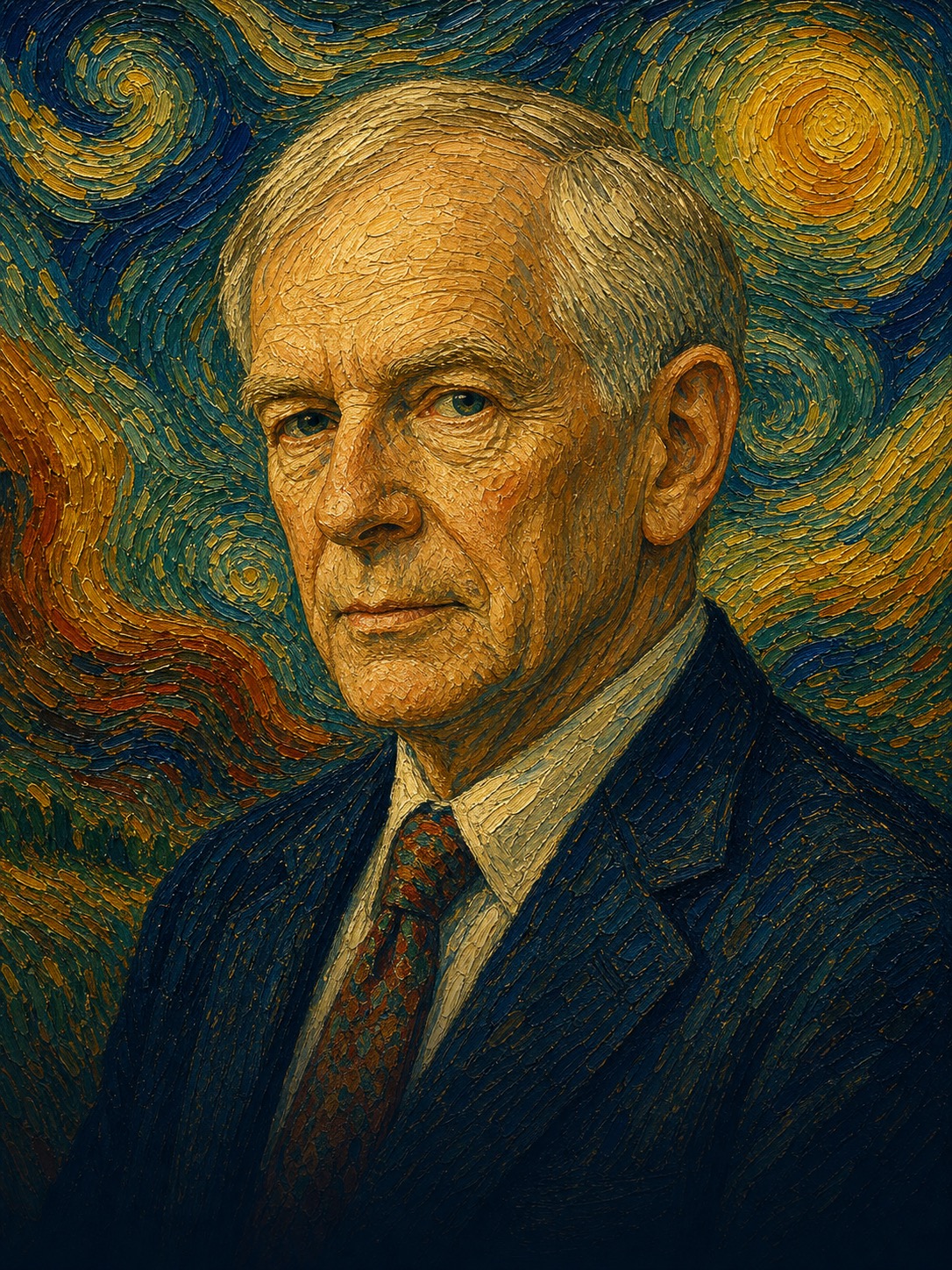
Jeremy Grantham
Built GMO's long-horizon valuation and bubble-analysis culture into a benchmark-agnostic asset-allocation framework, while showing that being right early only works when the mandate and clients can survive the path.
As of 2026-07-26, Robert Jeremy Goltho Grantham is living and remains a central figure at GMO as co-founder, board chairman, partner, asset-allocation team member, and long-term investment strategist. The current regulatory boundary matters: GMO's July 2026 Form ADV Part 2B identifies him as Chief Investment Strategist, but says he is not responsible for day-to-day discretionary advice; current Benchmark-Free and Global Asset Allocation portfolio-management responsibility sits with Ben Inker and John Thorndike (GMO ADV Part 2B, 2026).
Snapshot
| Field | Detail |
|---|---|
| Born / died | Born October 1938; living as of 2026-07-26. Companies House confirms his legal name, birth month/year, and British nationality; exact day and place are left open because no primary birth record was located in this run (Companies House). |
| Nationality | British; U.S.-based for most of his investment career (Companies House; GMO Firm Management, 2026). |
| Primary vehicles | Batterymarch Financial Management, co-founded 1969; Grantham, Mayo, Van Otterloo & Co. LLC / GMO, co-founded 1977; GMO Trust, GMO ETF Trust, private funds, separate-account mandates; Grantham Foundation for the Protection of the Environment, established 1997 with Hannelore Grantham (GMO Firm Management, 2026; GMO ADV Part 2A, 2026; Grantham Foundation About). |
| Years active | 1969-present in investment management; before that, Royal Dutch Shell economics work and Harvard Business School MBA 1966 (HBS Alumni Achievement Awards, 2025; GMO Firm Management, 2026). |
| Asset classes | Global equities, small-cap value, quantitative equities, tactical and benchmark-free multi-asset allocation, emerging markets, real assets/resources, climate-transition investments, alternatives, fixed income, currencies, and cash/T-bill defense (GMO Benchmark-Free Allocation Strategy Profile, 2026; GMO ADV Part 2A, 2026). |
| Style tags | Mean reversion; valuation-driven asset allocation; contrarian bubble analysis; benchmark agnosticism; career-risk arbitrage; quality/value discipline; climate and resource-risk investing. |
| Verified track record + period | Best public, measurable record is GMO's Benchmark-Free Allocation Strategy composite: 8.18% net annualized from 2001-07-31 inception through 2026-06-30, with $3.3 billion in strategy assets, but this is a GMO team record rather than a single-manager audited Grantham record (GMO Benchmark-Free Allocation Strategy Profile, 2026). |
| Peak AUM | GMO firmwide assets peaked around $155 billion in 2007 [single-source: Institutional Investor citing Morningstar]; GMO disclosed $76.8 billion of discretionary net AUM and $1.6 billion of non-discretionary net AUM as of 2025-12-31, while its Q1 2026 13F reported $39.095 billion of 13F securities value, which is not total AUM (Institutional Investor, 2016; GMO ADV Part 2A, 2026; SEC Form 13F, Q1 2026). |
Life & career timeline
1938-1966: Yorkshire, economics, and the move to the U.S. Grantham was born in October 1938 and grew up in Doncaster, Yorkshire. The University of Sheffield identifies him as a 1961 economics graduate, and Harvard Business School identifies him as MBA 1966 (University of Sheffield, 2016; HBS Alumni Achievement Awards, 2025). HBS's 2025 profile describes a short pre-HBS path through family business experience and Royal Dutch Shell economics work before he entered investment management (HBS Alumni Achievement Awards, 2025).
1969-1977: Batterymarch, quant value, and the indexing frontier. In 1969 Grantham co-founded Batterymarch Financial Management with Dean LeBaron and Richard Mayo. GMO's official biography says he recommended commercial indexing in 1971, before co-founding GMO in 1977 with Mayo and Eyk Van Otterloo (GMO Firm Management, 2026). Institutional Investor's 2014 lifetime-achievement profile casts Batterymarch as part of a small group that helped institutionalize quantitative investment management, international investing, tactical allocation, and value-oriented equities, but indexing itself should be treated as a shared early-1970s development involving several firms and researchers, not a Grantham-only invention (Institutional Investor, 2014; Capital Ideas, indexing history).
1974-1982: early small-cap value edge. Grantham later recalled that Batterymarch moved into small-cap value before those labels were standard institutional categories, and that the category outperformed dramatically from 1974 to 1982. The exact outperformance figure is self-reported and not reconstructed from account-level records in this run, but it is important as the seed of Grantham's later worldview: patient exposure to statistically cheap, institutionally under-owned assets can look foolish for a long stretch and then dominate in the round trip (Ritholtz Masters in Business transcript, 2018).
1977-1990: GMO and the Japan bubble. GMO was founded in 1977 as Grantham, Mayo, Van Otterloo & Co. LLC. Grantham later wrote that GMO sold Japanese equities in 1987, years before the top, when Japan was a huge share of global ex-U.S. equity indexes and traded at extreme valuation multiples. The Japan episode became one of his canonical examples of being too early, commercially uncomfortable, but directionally right about a market extreme (GMO Firm Management, 2026; Jeremy Grantham, "Waiting for the Last Dance," 2021).
1997-2002: the dot-com test. Grantham and GMO sold down discretionary U.S. equity exposure in the late 1990s after U.S. valuations exceeded prior extremes. His April 2000 writing documented the pressure on value managers, the extreme growth/value spread, and his rejection of efficient-market arguments at the peak (Jeremy Grantham, "Irrational Exuberance in the U.S. Equity Market," 2000). The call was reputationally and commercially painful before it worked. Publisher materials for his 2026 book emphasize that clients left GMO during that episode and that the bubble's collapse later vindicated the underlying valuation call (Grove Atlantic, The Making of a Permabear, 2026).
2001-present: Benchmark-Free Allocation. GMO launched the Benchmark-Free Allocation Strategy composite on 2001-07-31. The strategy is designed to seek positive total return through dynamic asset allocation, unconstrained by a traditional policy benchmark, and it is the cleanest public record of GMO's valuation-driven allocation process (GMO Benchmark-Free Allocation Strategy Profile, 2026).
2007-2009: defense, panic, and re-risking. In April 2007 Grantham argued that overvaluation had spread across real estate, stocks, bonds, risk premia, and leverage, making the period unusually dangerous (Jeremy Grantham, "It's Everywhere, In Everything," 2007). GMO later reported that Benchmark-Free had cut equity exposure to 25% before the crisis, drew down -19.3% net from the end of October 2007 through February 2009 versus -35.7% for a 60/40 global-equity/U.S.-aggregate-bond blend, and then re-risked during the panic (GMO, "A Second Opinion on the 60/40 Default," 2025). Grantham's March 2009 "Reinvesting When Terrified" is the most cited primary artifact from the buy-side of that trade (Jeremy Grantham, "Reinvesting When Terrified," 2009).
2009-2017: succession, AUM pressure, and the cost of being early. Institutional Investor reported that Grantham stepped back from day-to-day leadership of GMO's asset-allocation group after 2009 while remaining a major client-facing voice. It also reported that GMO's firmwide assets were $99 billion in 2016, down from roughly $115 billion the prior year and from a 2007 peak near $155 billion [single-source: Institutional Investor citing Morningstar]. Benchmark-Free, then GMO's largest strategy, had returned -4.17% in 2015 and only 0.80% annualized over three years through May 2016, a vivid example of the business risk embedded in long-horizon valuation investing (Institutional Investor, 2016).
2019-present: regulatory caveat, climate influence, and new bubbles. In 2019, a CME business-conduct committee settled with GMO over a lean-hog futures position-limit violation in five GMO-managed accounts, ordering a $15,000 fine and $314,160 disgorgement of profits; the notice did not require admission or denial and was a firm/account-level matter, not a personal Grantham fraud finding (CME disciplinary notice, 2019). In 2021-2026 Grantham remained active in public writing on U.S. equity overvaluation, "superbubble" risk, climate/resource pressure, and AI, including the 2026 essay "Valuing AI" with Edward Chancellor and the 2026 book The Making of a Permabear (Jeremy Grantham, "Let the Wild Rumpus Begin," 2022; Jeremy Grantham and Edward Chancellor, "Valuing AI," 2026; Grove Atlantic, 2026).
Vehicles & structure
Batterymarch Financial Management. Batterymarch was the formative pre-GMO vehicle. Its importance is not current AUM, but intellectual lineage: systematic equity investing, early indexing advocacy, international diversification, and small-cap/value exposure before those were standard institutional sleeves. Grantham's later public explanations present Batterymarch as the place where he learned both the power of quantitative valuation evidence and the career danger of being early (GMO Firm Management, 2026; Ritholtz Masters in Business transcript, 2018).
GMO LLC. GMO is the core investment-management platform. Its official description emphasizes nearly five decades of serving sophisticated institutions, families, and intermediaries with a long-term valuation philosophy, with offices in Boston, Amsterdam, London, Singapore, and Sydney (GMO About, 2026). The legal advisory entity is Grantham, Mayo, Van Otterloo & Co. LLC, a Massachusetts limited-liability company controlled by active employee-members, according to the 2026 Form ADV Part 2A (GMO ADV Part 2A, 2026).
GMO's current public materials separate Grantham's role from implementation. The firm-management page calls him Long-Term Investment Strategist and co-founder; the board page identifies him as chairman; and the ADV Part 2B says he is not responsible for day-to-day discretionary advice (GMO Firm Management, 2026; GMO Board of Directors, 2026; GMO ADV Part 2B, 2026). That boundary should govern every later attribution claim in this Canon series.
Public funds, private funds, ETFs, separate accounts. GMO's ADV describes advisory services through pooled vehicles, private funds, GMO Trust, GMO ETF Trust, and separately managed accounts. It also notes CFTC/NFA registration context for commodity-pool and commodity-trading-adviser activities, which matters because Benchmark-Free and related strategies can use futures, swaps, currencies, alternatives, and other derivatives in addition to cash securities (GMO ADV Part 2A, 2026).
Benchmark-Free Allocation and Global Asset Allocation. Benchmark-Free is the canonical public expression of Grantham/GMO's benchmark-agnostic allocation style. As of 2026-06-30, the Benchmark-Free profile listed total strategy assets of $3.3 billion and allocations of 44.0% equity, 29.6% alternatives, and 26.3% fixed income. It listed Ben Inker and John Thorndike as portfolio managers (GMO Benchmark-Free Allocation Strategy Profile, 2026). GMO's Global Asset Allocation Strategy is a more benchmark-aware cousin, targeting returns above a 65% MSCI ACWI / 35% Bloomberg U.S. Aggregate benchmark over a full cycle; it was $6.2 billion in strategy assets as of 2026-06-30 (GMO Global Asset Allocation Strategy, 2026).
Regulatory and reporting lenses. GMO's 2026 ADV Part 2A disclosed $76.8 billion of discretionary net AUM and $1.6 billion of non-discretionary net AUM as of 2025-12-31 (GMO ADV Part 2A, 2026). Its Q1 2026 SEC Form 13F showed 628 entries and $39.095 billion of 13F information-table value, but 13F should not be read as firm AUM because it excludes many asset classes and vehicles (SEC Form 13F, Q1 2026; Investor.gov Form 13F explainer).
Foundation and climate structure. The Grantham Foundation for the Protection of the Environment was established in 1997 by Jeremy and Hannelore Grantham, and the foundation site says they set direction for both the Foundation and the associated Trust (Grantham Foundation About). The foundation/Trust complex is not an investment-management vehicle in the same sense as GMO, but it is part of the Grantham record because it shaped his public emphasis on climate, resources, carbon risk, and green-technology investment. The foundation helped establish climate institutes at Imperial College and the London School of Economics, and Grantham received a CBE in the 2016 UK Birthday Honours for philanthropic service to climate-change research (Grantham Foundation Philanthropy; UK Birthday Honours List, 2016).
Track record detail with caveats
There is no simple "Jeremy Grantham fund return" comparable to a single-partner hedge-fund record. The evidence base is a stack of overlapping records: Batterymarch-era recollections, GMO firm outcomes, strategy composites, public fund returns, tactical calls documented in letters, and client/business outcomes. The safest summary is that Grantham built one of the most durable institutional value/allocation research franchises in public markets, but the measurable numbers mostly belong to GMO strategies and teams, not to Grantham alone.
Early small-cap value and indexing record. The early Batterymarch record is historically important but thinly audited in public. Grantham's own 2018 interview says Batterymarch entered small-cap value before "small" and "value" were normal institutional buckets and that the opportunity compounded dramatically in 1974-1982; because this run did not locate Batterymarch client-account statements, the exact outperformance should remain [self-reported/single-source] (Ritholtz Masters in Business transcript, 2018). The indexing contribution is likewise best stated as "early pioneer," not inventor: Batterymarch was one of several firms pushing institutional indexing before the idea became common (Capital Ideas, indexing history).
Benchmark-Free composite. The cleanest current public performance record is GMO Benchmark-Free Allocation. The June 30, 2026 strategy profile reports 8.18% net annualized since 2001-07-31, 6.65% over ten years, 8.60% over five years, 14.95% over three years, and 23.33% over one year. It also reports a 5-year trailing maximum drawdown of -12.23% from 2022-01-31 to 2022-09-30 and $3.3 billion in strategy assets (GMO Benchmark-Free Allocation Strategy Profile, 2026). Those are real strategy numbers, but they come with three caveats. First, the profile identifies Inker and Thorndike as current PMs, and the ADV Part 2B says Grantham is not the day-to-day discretionary adviser. Second, recent returns were boosted by unusual items: the 2026 profile discloses that a litigation settlement recovery contributed 2.45% to 2024 return and that Russian-securities sale proceeds contributed 0.93% to return. Third, the strategy's design can lag badly when the expensive asset keeps outperforming.
GFC defense and re-risking. The 2007-2009 period is the strongest Grantham/GMO cycle in the public record. Grantham's April 2007 letter identified broad overvaluation and compressed risk premia across assets before the crisis (Jeremy Grantham, "It's Everywhere, In Everything," 2007). GMO later reported that Benchmark-Free had reduced equities to 25% by 2007-2008 and lost far less than a 60/40 blend through the crisis, then re-risked near the panic low (GMO, "A Second Opinion on the 60/40 Default," 2025). Institutional Investor separately reported that Benchmark-Free had only 18% equity exposure before the 2008 break and returned 19.86% in 2009 (Institutional Investor, 2016). This is the best candidate for "skill plus execution" in the Grantham record, but even here, execution belongs to GMO's asset-allocation process and team.
The cost of being early. Grantham's biggest weakness is not that his valuation calls are always wrong; it is that they can be right too early for client patience, career risk, and business survival. Japan, dot-com, and GFC all involved early pain. The 2015-2021 period was more damaging because U.S. mega-cap growth kept compounding while GMO favored cheaper non-U.S., value, and alternative exposures. Institutional Investor's 2016 article captured that pressure in real time: Benchmark-Free was GMO's largest strategy at $27.3 billion but had returned -4.17% in 2015 and only 0.80% annualized over three years through May 2016; firmwide AUM had fallen from earlier peaks (Institutional Investor, 2016). MarketWatch later reported that investors had pulled heavily from GMO, with AUM around $80 billion in January 2017 after a June 2014 cycle peak of $124 billion (MarketWatch, 2017).
Skill versus luck. The strongest evidence for skill is pattern recurrence across unrelated regimes: small-cap value, Japan, dot-com, the pre-GFC defense, and the March 2009 re-risking all reflect the same valuation, mean-reversion, and career-risk framework rather than a single lucky macro forecast. The strongest evidence against overclaiming is also clear: the public record is mostly firm and strategy evidence, not a clean personal account; large valuation gaps can persist for years; and the same willingness to be early produced real client withdrawals and long stretches of underperformance. Grantham's edge is therefore best categorized as institutional process plus unusual time horizon, not market-timing precision.
Legal and adverse record. This run located no personal Grantham SEC enforcement action, fraud finding, or court judgment. The adverse record is mainly firm-level. GMO's Form CRS answers "Yes" to the legal/disciplinary-history prompt, while GMO's ADV Part 2A says there are no legal or disciplinary events GMO believes material to evaluating its advisory business or management integrity (GMO Form CRS, 2026; GMO ADV Part 2A, 2026). GMO Trust's June 30, 2026 SAI separately discloses fund-level legal proceedings and other matters, including the Emerging Markets Fund's restricted assets in India and several tax/refund appeals in Spain, Italy, and India; these are fund-level matters, not personal Grantham findings (GMO Trust SAI, 2026). The most concrete disciplinary item found was the 2019 CME settlement over position limits in five GMO-managed lean-hog futures accounts, with a $15,000 fine and $314,160 disgorgement (CME disciplinary notice, 2019). It should be carried as a firm-level compliance caveat rather than transformed into a personal misconduct claim.
Why they matter
Grantham matters because he turned a few stubborn ideas into a lasting institutional machine.
First, he helped move value from a stock-picking slogan into a cross-asset, quantitative, valuation-forecasting discipline. GMO's seven-year asset-class forecasts, Benchmark-Free allocation work, and "mean reversion" vocabulary made long-horizon expected-return forecasting an allocator operating system rather than a one-off bearish opinion (GMO Benchmark-Free Allocation Strategy Profile, 2026; GMO Asset Allocation Solutions, 2026).
Second, he helped make bubble analysis respectable inside institutional capital. Grantham's framework is not merely "prices are high"; it studies deviations from trend, breadth, speculative behavior, cross-asset overvaluation, and the social conditions that make intelligent investors reluctant to stand aside. His Japan, dot-com, housing/credit, 2021-2022 "superbubble," and 2026 AI writings form a long public case file on how real innovation and bad prospective returns can coexist (Jeremy Grantham, "Let the Wild Rumpus Begin," 2022; Jeremy Grantham and Edward Chancellor, "Valuing AI," 2026).
Third, he is one of the clearest public analysts of career risk. His 2012 essay "My Sister's Pension Assets" argues that professional investors often know what long-term valuation suggests but cannot survive the interim underperformance required to benefit from it (Jeremy Grantham, "My Sister's Pension Assets," 2012). That idea ties the whole career together: if the market offers its largest rewards to investors who can wait, then the scarcest asset is not a spreadsheet but a client base, governance structure, and temperament willing to look wrong.
Fourth, Grantham's climate and resource work makes him broader than a conventional market historian. The Grantham Foundation helped build climate-research institutions, and GMO's later climate-investing papers frame climate risk as both a social emergency and an investable set of resource, inflation, and transition exposures (Grantham Foundation Philanthropy; Lucas White and Jeremy Grantham, "Thinking Outside the Box," 2019). The caveat is obvious: philanthropy, advocacy, GMO products, and personal worldview overlap. Later tasks should keep separating evidence, incentives, and investment results.
Finally, he is a cautionary model of the business cost of principled investing. Grantham's greatest edge, an unusually long horizon, is also the feature that made GMO vulnerable to client withdrawals when the expensive asset kept winning. That tension is not a side note; it is the central lesson. A Grantham-like process requires more than valuation insight. It requires a mandate designed to survive being painfully early.
Open questions for later tasks
- Can a primary birth record be located to verify exact day and place of birth? Companies House supports October 1938 and British nationality; lower-quality sources give a specific day/place, but this profile does not treat them as settled.
- Can Batterymarch-era client records or contemporaneous press verify the 1974-1982 small-cap value outperformance figure beyond Grantham's later recollection?
- What is the best fully audited, strategy-by-strategy GMO performance series available for Benchmark-Free, Global Asset Allocation, Quality, Emerging, and Equity Dislocation, and how much can be fairly attributed to Grantham?
- Can the $155 billion 2007 peak AUM figure be confirmed from a primary GMO, ADV, Morningstar, or pension-consultant source rather than Institutional Investor's single-source Morningstar attribution?
- How did client withdrawals and mandate losses from 2015-2021 change GMO's investment process, product lineup, staffing, or risk limits?
- How should later tasks separate Grantham's public bubble warnings from investable GMO trades, especially for live calls on AI, U.S. equities, climate/resources, and Equity Dislocation?
- Are there additional firm-level legal, regulatory, or client-dispute records after the 2019 CME matter that should be incorporated in the mistakes-and-losses task?
- What is the best primary evidence on the foundation and Trust's capital allocation, green-technology investments, conflicts, and measurable philanthropic outcomes?
As of 2026-07-26, Jeremy Grantham remains GMO's co-founder and Chief Investment Strategist, but GMO's July 2026 Form ADV Part 2B says he is "not responsible for day-to-day discretionary advice" to clients (GMO Form ADV Part 2B, 2026). This file therefore treats "Grantham philosophy" as the intellectual framework he built and still publicly articulates, while separating it from current portfolio implementation by GMO's asset-allocation and investment teams.
Core Worldview
Grantham's worldview starts with a simple but uncomfortable claim: markets are not efficiently anchored to fair value over professional-investor time horizons. GMO's own asset-allocation strategy pages state the house doctrine plainly: asset-class prices can deviate from intrinsic value in the short term and mean-revert over a complete market cycle; GMO's proprietary seven-year forecasts are the core framework for judging the opportunity embedded in different asset classes (GMO Global Asset Allocation Strategy, 2026; GMO Benchmark-Free Allocation Strategy, 2026).
His intellectual home is historical base rates rather than near-term forecasting. In the 2026 AI paper with Edward Chancellor, Grantham again framed the market as extrapolating record earnings, AI progress, and a strong economy "as if these conditions are guaranteed forever," while warning that a deflating AI bubble could hit profits and valuations together (Grantham and Chancellor, 2026). The point is not that great technologies are fake. In both the 2026 AI paper and his 2026 Diary of a CEO interview, he argues the most dangerous bubbles usually form around genuinely transformative ideas - railways, the internet, and now AI - because investors overpay for the aggregate benefit and underestimate competitive destruction (Grantham and Chancellor, 2026; Diary of a CEO transcript, 2026).
That worldview has a second pillar: short-term career risk is the largest systematic pricing error in professional markets. In "My Sister's Pension Assets and Agency Problems," Grantham argues that professional investors herd because being wrong alone is career-threatening. The result is benchmark-aware momentum, bubble formation, and deep undervaluation in assets that are socially difficult to own (Grantham, 2012). GMO's Asset Allocation Solutions page still describes the process as trying to look past the "emotions of the moment" through top-down asset-class valuation, a framework conceived decades ago by a group including Grantham (GMO Asset Allocation Solutions, 2026).
The third pillar is finite-planet realism. Grantham's investment letters moved from pure valuation and bubbles into resources, climate, toxicity, and fertility because he sees natural capital as an economic constraint that conventional models underweight. "Time to Wake Up" argued that the long decline in raw-material prices had broken under emerging-market demand and finite supply (Grantham, 2011). "The Race of Our Lives" and its 2018 update frame climate, population, food systems, and green technology as the central long-horizon economic problem, not merely a philanthropic side issue (Grantham, 2013; Grantham, 2018).
The Edge - What Markets Misprice And Why
Grantham's edge is not informational secrecy; it is willingness to be lonely for a long time. He believes markets misprice three broad things.
First, they misprice valuation dispersion. Expensive assets are often priced as if high margins, high multiples, and recent growth persist indefinitely; cheap assets are often priced as if bad conditions never normalize. The live 2Q 2026 GMO seven-year forecast still expresses this philosophy mechanically: under a normal interest-rate environment, GMO's real-return estimates are deeply negative for U.S. large and small stocks but materially positive for several non-U.S. value, emerging, bond, and cash categories; the forecast warns that it is not a guarantee and depends on assumptions that can change (GMO 7-Year Asset Class Forecast, 2026).
Second, they misprice behavioral agency. In Grantham's 2012 paper, career risk creates herding because managers are measured against peers and benchmarks over short intervals, while clients rarely tolerate years of looking different (Grantham, 2012). This is why GMO's Benchmark-Free Allocation strategy is central to the philosophy: it tries to allocate dynamically across asset classes without traditional benchmark ranges, constrained mainly by the refusal to overpay (GMO Benchmark-Free Allocation Strategy, 2026).
Third, they misprice slow-moving structural constraints. Resource depletion, climate risk, and environmental damage develop too slowly for quarterly incentives but can reshape inflation, margins, asset lives, and required capital spending. GMO's climate-change strategy materials frame climate transition not as charity, but as a decades-long secular growth and diversification opportunity, with companies tied to mitigation, adaptation, and resource efficiency (GMO Climate Change Strategy, 2026; White and Grantham, 2019).
Process: Idea Sourcing To Sell Discipline
Idea sourcing. Grantham's process begins top-down. GMO's current asset-allocation page says top-down asset-class valuation is the basis of its views and that the seven-year forecast framework is used to find attractively valued long-term opportunities (GMO Asset Allocation Solutions, 2026). The 2025 UK Stewardship Code report gives a useful implementation clue: GMO describes long-term forecasts as monthly outputs that assume asset classes move one-seventh of the way toward fair value each year, with other factors such as income and growth layered in (GMO UK Stewardship Code Report, 2025).
Research. The research method is historical and comparative. In 2000, Grantham's "Irrational Exuberance in the U.S. Equity Market" treated technology-stock valuation as a repeatable mania rather than a new law of economics (Grantham, 2000). In 2007, "It's Everywhere, In Everything" argued that excellent fundamentals and cheap credit had pushed multiple asset classes into bubble territory, a setup where the absence of an obvious catalyst did not remove the risk (Grantham, 2007). In 2026, the AI paper reused the same comparative method by setting AI beside prior technology manias (Grantham and Chancellor, 2026).
Valuation and entry. Entry is valuation-driven, not headline-driven. GMO's Global Asset Allocation and Benchmark-Free pages both say the firm allocates to the most attractively priced asset classes identified by seven-year forecasts (GMO Global Asset Allocation Strategy, 2026; GMO Benchmark-Free Allocation Strategy, 2026). In "Reinvesting When Terrified," Grantham describes crisis buying as a pre-agreed battle plan: investors should decide in advance what fair value looks like, buy in a few large steps, and accept that value investors rarely catch the exact bottom (Grantham, 2009).
Sizing. Grantham favors meaningful, uncomfortable deviations when expected returns are extreme. The 2012 agency-problem paper argues that protecting client money in bubbles or exploiting cheap assets requires embracing career risk, sometimes dramatically (Grantham, 2012). But current implementation is not a one-man macro punt. GMO's July 2026 ADV Part 2B lists Ben Inker and John Thorndike as day-to-day members for Global Allocation Absolute Return, Benchmark-Free Allocation, Global Asset Allocation, and related strategies; it explicitly says Grantham is not responsible for day-to-day discretionary advice (GMO Form ADV Part 2B, 2026).
Portfolio construction. The mature GMO process is a portfolio of forecasted opportunities, not simply "short the market." Benchmark-Free, Global Asset Allocation, quality, resources, climate, emerging-market, and dislocation strategies all express different parts of the philosophy: valuation-aware dynamic allocation, security selection within asset classes, and the use of liquid alternatives or long/short expressions when dislocations are unusually wide (GMO Form ADV Part 2A, 2026; GMO Asset Allocation Solutions, 2026). Quality investing is a notable evolution rather than a contradiction: GMO's quality materials emphasize high, stable profitability and low leverage as persistent attributes that can reduce downside while still requiring price discipline (GMO Quality: The Real McCoy, 2023; Inker, 2023).
Sell discipline. Grantham's sell discipline is to reduce or avoid assets with poor forward returns, not to call the top. "Waiting for the Last Dance" admits that bubbles can keep rising after they appear absurd and that timing their break has a long history of disappointment (Grantham, 2021). "Bracing Yourself for a Possible Near-Term Melt-Up" similarly revised a simple two-sigma valuation trigger by emphasizing that price alone is not enough; euphoria and market behavior matter (Grantham, 2018). The practical sell rule is therefore probabilistic: when prospective real returns are inadequate, lower exposure, accept underperformance risk, and preserve capital for reinvestment.
Risk Management
Grantham defines risk as permanent impairment, overpayment, client impatience, and ecological or institutional fragility - not just volatility. GMO's product pages still disclose ordinary market and operational risks, including that GMO's techniques may fail to produce desired results (GMO Benchmark-Free Allocation Strategy, 2026). The sharper Grantham point is that risk is often highest when measured volatility looks benign, because complacency and cheap credit are late-cycle features.
The crisis rule is precommitment. In 2009, he warned that investors who wait for perfect clarity will miss the turn; the antidote is a battle plan made before panic arrives (Grantham, 2009). The bubble rule is symmetric: if an asset's price embeds absurd future assumptions, one reduces exposure even though a melt-up may continue. The career-risk rule is organizational: the client base, board, and portfolio team must understand that a benchmark-free strategy may look foolish for years. Without that contract, the strategy gets liquidated at the wrong time.
Temperament And Psychology
Grantham's temperament is contrarian but not impulsive. In the 2018 Masters in Business transcript, Barry Ritholtz introduces him as value-oriented, data-aware, and willing to be early in avoiding excess; Grantham's own discussion repeatedly returns to bubbles, moral hazard, and the psychological difficulty of acting against the crowd (Ritholtz transcript, 2018). In the 2026 Diary of a CEO transcript, Grantham says he specializes in a longer-term horizon and in asking what people are missing, especially given human short-termism and optimism (Diary of a CEO transcript, 2026).
His psychology also includes a taste for scale. He does not merely ask whether a security is cheap; he asks whether an entire system is mispriced. That makes his work unusually useful during bubbles and resource transitions, but it also makes him vulnerable to sounding like a permanent pessimist. The 2026 book materials for The Making of a Permabear, written with Edward Chancellor, explicitly frame mean reversion as the central principle he saw after building early small-cap and value indices; the Library of Mistakes summary also notes client departures during the late-1990s refusal to buy dot-com mania (Amazon book page, 2026; Library of Mistakes, 2026).
Evolution Over Career
The early Grantham was a quantitative value and indexing pioneer. GMO's 2026 AI paper biography states he co-founded Batterymarch in 1969, recommended commercial indexing in 1971, and co-founded GMO in 1977 (Grantham and Chancellor, 2026). The middle-period Grantham became the public bubble historian: Japan, U.S. technology, housing, and the 2007 "everything" bubble. The post-2010 Grantham added resource scarcity and climate transition. The post-2020 Grantham has continued the bubble framework through U.S. growth, duration risk, and AI while acknowledging that monopoly power, software economics, and very low rates can slow the old reversion timetable (Grantham, 2017; Grantham and Chancellor, 2026).
The biggest evolution is that he no longer treats mean reversion as a mechanical seven-year clock. The 2017 "I Do Indeed Believe..." essay is the key corrective: he still expected U.S. valuations and margins to move toward old means, but argued the process could be much slower than GMO's classic framework assumed (Grantham, 2017). GMO's 2025 and 2026 process materials show the institutional version of that adaptation: forecasts remain valuation-based, but they incorporate multiple interest-rate scenarios and are explicitly forward-looking, assumption-dependent, and not promises (GMO 7-Year Asset Class Forecast, 2026; GMO UK Stewardship Code Report, 2025).
What He Explicitly Rejects
Grantham rejects efficient-market complacency in bubble periods. He also rejects static policy portfolios when valuation spreads are extreme: GMO's 2025 "Second Opinion on the 60/40 Default" argues that a traditional allocation can embed unintended concentration in expensive U.S. assets after a long bull market, and that valuation-aware dynamic allocation may reduce drawdown risk and improve forward returns (GMO Asset Allocation Team, 2025).
He rejects benchmark worship. The 2012 paper treats benchmark and peer comparison as the institutional machinery behind bubbles (Grantham, 2012). He rejects price-insensitive enthusiasm for technology: the 2026 AI paper explicitly allows that AI may be a new golden era and still an extreme bubble (Grantham and Chancellor, 2026). He rejects fossil-fuel complacency and narrow GDP optimism; his climate and sustainability writings argue that environmental damage can flatter short-term activity while eroding real wealth (Grantham, 2013; Grantham, 2024).
He does not reject all growth or all risk. Climate-change strategy materials seek growth companies tied to transition, but at a discount; quality materials seek better businesses, but still through valuation discipline (White and Grantham, 2019; GMO Quality: The Real McCoy, 2023). The rejection is overpayment, not innovation.
Regimes Where It Thrives Vs. Struggles
The philosophy thrives when valuation spreads are wide and mean reversion arrives within the patience horizon. It worked best around classic manias and panics: late-1980s Japan, 1999-2002 technology, 2007-09 risk assets, and post-bust reinvestment windows. GMO's 2025 quarterly letter argues that Benchmark-Free reduced the 2007-09 real drawdown relative to a 60/40 portfolio and had outperformed a 60/40 benchmark from the end of 2021 through November 18, 2025, though those figures are GMO-reported and strategy-specific, not a complete Grantham personal record (Inker, 2025).
It struggles in momentum regimes where expensive assets get more expensive for years. Institutional Investor reported in 2016 that GMO's mean-reversion strategy was being tested: Benchmark-Free was down 4.17% in 2015, had annualized only 0.80% over the previous three years, firm AUM had fallen from $155 billion in 2007 to $99 billion, and some pension clients had terminated or put GMO on watchlists (Institutional Investor, 2016). A 2017 Institutional Investor profile described GMO betting heavily on emerging markets while AUM had fallen to $74 billion from $124 billion in June 2014 (Institutional Investor, 2017).
It also struggles when structural changes make old averages less reliable. Grantham's 2017 admission that U.S. margins and P/Es might revert very slowly is important because a naive reading of his work can turn "mean reversion" into a stopwatch. The stronger reading is probabilistic: valuation matters, but the path depends on rates, monopoly power, margins, politics, and investor mandates (Grantham, 2017).
Tensions Between Stated Philosophy And Actual Behavior
Timing is the central tension. Grantham often says he cannot time bubble breaks, but public warnings naturally sound like timing calls. Critics have highlighted repeated warnings that were early or costly to follow. Business Insider summarized the criticism in 2022: a 2010 warning was followed by a large S&P 500 advance, a 2018 melt-up concern preceded further gains, and his 2020-21 warnings were early while U.S. equities continued rising for a time (Business Insider/Markets Insider, 2022). The fairest conclusion is that his process is better at identifying bad forward odds than at specifying the month those odds matter.
Client fit is another tension. Grantham's philosophy requires tolerating long benchmark deviations, yet GMO is an institutional adviser whose clients can redeem. The 2016-17 AUM drawdowns and client-watchlist reports show that career-risk theory applies to GMO's own business, not just to other investors (Institutional Investor, 2016; MarketWatch, 2017).
Attribution is a third tension. Grantham is the public voice, but GMO's current strategies are team-run. ADV Part 2B says he is not the day-to-day discretionary adviser, while listing Ben Inker, John Thorndike, Tom Hancock, Lucas White, and others across asset-allocation, quality, resources, and climate products (GMO Form ADV Part 2B, 2026). Future trade and performance files should avoid attributing every GMO position to Grantham personally.
Regulatory and conflict caveats are modest but real. GMO's 2026 ADV Part 2A says it has no material legal or disciplinary events, but the client relationship summary answers "Yes" to legal or disciplinary history, and CME records show a 2019 settlement involving GMO-managed accounts exceeding lean hog futures position limits, with a $15,000 fine and $314,160 disgorgement, without admission or denial (GMO Form ADV Part 2A, 2026; GMO CRS, 2025; CME disciplinary notice, 2019). These do not overturn the philosophy, but they should keep the Canon from presenting GMO as frictionless or conflict-free.
Climate investing creates perception risk. Grantham's foundation and GMO climate/resource work align philosophically, but they can also look self-interested when policy favors green technology. In a 2022 Conversations with Tyler transcript, he said the Grantham Foundation had half its principal in early-stage green tech that would benefit from U.S. climate legislation (Cowen interview, 2022). The Guardian also pressed him in 2013 on resource, forestry, and fossil-fuel exposure, a useful reminder that climate philosophy, public equity resource investing, and philanthropic activism can coexist uneasily (Guardian interview, 2013).
The synthesis is therefore sharp but bounded: Grantham's philosophy is one of the clearest modern expressions of long-horizon, valuation-aware institutional contrarianism. Its power comes from refusing benchmark obedience when prices are absurd. Its weakness is that the market can keep making absurdity look profitable longer than clients, committees, and public audiences can comfortably endure.
As of 2026-07-26, Jeremy Grantham remains GMO's co-founder and Chief Investment Strategist, but GMO's July 2026 Form ADV Part 2B says he is not responsible for day-to-day discretionary advice. This file therefore treats him as the strategist, historian, and public owner of the market calls, while attributing measurable portfolio results to GMO strategies and teams unless a source supports a personal account. The pending A-profile file for T0754 was still freshly claimed and absent on main when this chapter was written, so this chapter is self-contained on attribution and evidence limits. GMO ADV Part 2B
The single best Grantham/GMO trade was the 2007-09 Global Financial Crisis defense followed by the March-April 2009 re-risking. It has the strongest combination of primary pre-crisis warning, documented strategy positioning, quantified drawdown mitigation, and a direct primary-source call to buy during panic. The 1997/99-2002 dot-com trade and 1987 Japan exit were probably more famous reputation-makers, but their exact client-account P&L is less well disclosed. GMO's recent 2021-25 positioning and Equity Dislocation strategy are also powerful, but they are partly ongoing and must be separated from Grantham personally.
Evidence And Ranking Caveats
Grantham is a bubble caller, allocator, and institutional strategist more than a single-security trader. For that reason, the "trades" below are mostly portfolio-level allocation calls: reducing exposure to overpriced markets, emphasizing cheaper styles or regions, using long/short structures, and re-risking after panic. Where possible, this chapter gives fund, composite, or strategy results; where not possible, it explicitly says the P&L was not found.
Three caveats matter throughout. First, being early was part of the record: Grantham himself says GMO was three years early in Japan and sold U.S. equities rapidly in late 1997 before the S&P 500 valuation kept rising. Waiting for the Last Dance Second, commercial pain was real: Institutional Investor reported in 2016 that GMO assets had fallen to about $99 billion from roughly $115 billion the prior year and a 2007 peak near $155 billion, with Benchmark-Free underperformance and public-pension pressure visible. Institutional Investor - GMO's Mean-Reversion Strategy Is Tested Third, regulatory/legal review found one modest but real exchange-disciplinary caveat: CME reported a 2019 position-limit settlement involving GMO-managed accounts, a $15,000 fine, and $314,160 disgorgement, while GMO's 2026 ADV says GMO does not view any legal or disciplinary event as material to evaluating its advisory business or management integrity. CME notice GMO ADV Part 2A
1. 2007-09 GFC Defense And "Reinvesting When Terrified" - Single Best
Context and dates: The setup began before the crisis, with Grantham's April 2007 letter "It's Everywhere, In Everything," continued through GMO's defensive Benchmark-Free positioning in 2007-08, and culminated in Grantham's March 2009 "Reinvesting When Terrified." The round trip is the best-documented Grantham/GMO trade because the call covered both sides: avoid overpriced risk in 2007-08 and buy when expected returns turned attractive in early 2009. It's Everywhere, In Everything Reinvesting When Terrified
Thesis and how he found it: Grantham's 2007 thesis was that exceptionally good fundamentals, cheap leverage, tight spreads, and complacent risk-taking had pushed assets into broadly unattractive territory. His risk-premium chart showed that the extra return available from taking risk had collapsed from 6.4 percentage points in September 2002 to 0.8 percentage points by April 2007. This was not a subprime-only thesis; he argued that expensive assets and loose financing appeared nearly everywhere. It's Everywhere, In Everything
Size and structure: The clearest measurable vehicle is GMO Benchmark-Free Allocation. GMO later reported that as valuations reached extreme levels in 2007-08, Benchmark-Free reduced equity exposure to 25%, allocated that equity to U.S. quality stocks, and preferred a long-quality/short-junk position. The June 2026 Benchmark-Free profile shows the August 2008 historical allocation snapshot with equities at 25%, quality at 25%, strategic fixed income at 30%, absolute return and cash at 43%, and only small EM debt exposure. Improving on the Traditional 60/40 Allocation Benchmark-Free Allocation Strategy Profile
Entry and path, including drawdown endured: The defense was not painless. GMO's own later comparison says Benchmark-Free fell 19.3% net from the end of October 2007 through February 2009, while a 60/40 MSCI ACWI/Bloomberg U.S. Aggregate portfolio fell 35.7% and global equities fell 55%. A 2025 GMO quarterly letter frames the real drawdowns as roughly -20% for Benchmark-Free versus -37% for a 60/40 blend. The key was not avoiding all losses; it was preserving capital and behavioral room while others were forced to sell. Improving on the Traditional 60/40 Allocation GMO 4Q 2025 Quarterly Letter
Exit and P&L: Grantham's March 2009 letter argued for a pre-agreed buying schedule and said GMO had already made a large October 2008 reinvestment move, with more buying planned if markets fell. The Benchmark-Free June 2026 profile shows an April 2009 historical allocation snapshot with equity exposure up to 52%, including emerging equity, Japanese equities, international small cap, REITs, and quality. GMO later wrote that Benchmark-Free made a new real high by the end of 2009, while the 60/40 portfolio did not regain its 2007 real peak until 2013. Exact position-level P&L was not found. Reinvesting When Terrified Benchmark-Free Allocation Strategy Profile GMO 4Q 2025 Quarterly Letter
What it teaches: This was Grantham's ideal full-cycle trade: valuation triggered the warning, courage and client discipline allowed the defense, and precommitment allowed re-risking before the narrative felt safe. It also shows why "market timing" is the wrong label. The edge was not day-perfect top calling; it was refusing a terrible risk/reward trade and then having a process ready when expected returns turned positive.
Sources: GMO 2007 letter, GMO 2009 letter, GMO Benchmark-Free profile, GMO 2025 60/40 paper, GMO 4Q 2025 letter, Institutional Investor 2016 criticism/performance article.
2. Dot-Com And TMT Avoidance, 1997/99-2002
Context and dates: The dot-com trade began before the March 2000 peak. Grantham later wrote that GMO rapidly sold down discretionary U.S. equity positions in late 1997 as the S&P 500 passed its prior 1929 valuation peak, then watched the market advance to 35 times earnings before the break. GMO's April 2000 letter "Irrational Exuberance in the U.S. Equity Market" captured the pressure on value managers and the two-tier market at almost the top. Waiting for the Last Dance Irrational Exuberance in the U.S. Equity Market
Thesis and how he found it: Grantham's model saw U.S. large-cap growth and technology as priced for impossibly good outcomes, while value, small-cap value, REITs, emerging markets, timber, and market-neutral strategies offered much better prospective returns. The April 2000 paper leaned on Robert Shiller's evidence against market efficiency, extreme tech-stock enthusiasm, and the historical tendency for value spreads to mean-revert. Irrational Exuberance in the U.S. Equity Market
Size and structure: GMO's later reconstruction of the fall-1999 "Benchmark Agnostic" proposal shows a deliberately benchmark-free portfolio: 40% in risky assets split among REITs, emerging-market equity, and emerging-market debt, and 60% in TIPS and U.S. investment-grade bonds. A 2025 GMO exhibit also reconstructs a January 2000 positioning with a 32% underweight to U.S. large caps, a 14% overweight to U.S. small value plus REITs, a 5% overweight to EM equities, and a 12% overweight to fixed income. GMO notes, however, that it was not hired to run a live Benchmark-Free portfolio until fall 2001, so this is partly a model/client-account architecture rather than a clean single composite. It's Probably a Bubble, But There Is Plenty Else to Invest In GMO 4Q 2025 Quarterly Letter
Entry and path, including drawdown endured: This was the canonical career-risk trade. Grantham says GMO lost half of its Asset Allocation book of business while the market kept rising. In another interview transcript, he described the psychological and business damage as clients watched benchmark returns run away from them. Institutional Investor later wrote that GMO's mean-reversion approach was tested by exactly this kind of period: a manager can be right on valuation and still suffer business losses before the cycle turns. Waiting for the Last Dance Ritholtz Masters in Business transcript Institutional Investor - GMO's Mean-Reversion Strategy Is Tested
Exit and P&L: Grantham says GMO more than made up its losses in the ensuing decline, but no audited position-level P&L was found for the 1997-2002 accounts. The market backdrop supports the magnitude: GMO's 2021 discussion recalls the Nasdaq collapse after the tech bubble, and GMO's own later work says its January 2000 S&P 500 real-return forecast was strongly negative and directionally correct over the following decade. Exact client-level gains by sleeve remain unverified. Waiting for the Last Dance It's Probably a Bubble, But There Is Plenty Else to Invest In
What it teaches: The dot-com call shows Grantham's central trade-off: a valuation process can protect long-term capital while inflicting near-term tracking-error and business risk. The real skill was not saying "tech is expensive"; it was building a portfolio that could survive without owning the benchmark's most beloved securities.
Sources: GMO 2000 paper, GMO 2021 "Waiting for the Last Dance," GMO 4Q 2025 letter, GMO 2025 bubble/Benchmark-Free letter, Ritholtz transcript, Institutional Investor 2016.
3. Japan Equity Bubble Exit, 1987-Early 1990s
Context and dates: GMO exited Japan in 1987, before the late-1989 peak of the Japanese equity bubble. Grantham later framed Japan, the 2000 tech bubble, and the 2008 housing/mortgage crisis as the defining market events of his investment life. Waiting for the Last Dance
Thesis and how he found it: The thesis was pure valuation discipline. Grantham wrote that Japan was over 40% of the EAFE benchmark and traded above 40 times earnings when GMO got out, far above a prior all-time high near 25 times. GMO's 2022 "Wild Rumpus" table independently summarizes the firm action as a zero weight in Japan in the International Equity portfolio during the 1989 Japanese equity bubble. Waiting for the Last Dance Let the Wild Rumpus Begin
Size and structure: The trade was an outright avoidance trade: GMO went to zero Japan in the relevant international equity allocation. No exact dollar size or percentage of firm assets was found. The known percentage is benchmark-relative: Japan was more than 40% of EAFE when GMO exited and later exceeded 60% of the benchmark as the bubble stretched. Waiting for the Last Dance
Entry and path, including drawdown endured: This was one of the most painful examples of being early. Grantham says GMO underperformed for three years as Japan's market valuation rose from above 40 times earnings to about 65 times, and as Japan's EAFE weight climbed above 60%. The choice reduced eventual risk, but it created years of benchmark regret. Waiting for the Last Dance
Exit and P&L: Grantham says GMO stayed completely out for three years after the top and ultimately made good money on the round trip. No exact trade-level P&L, client-account return, or international-equity composite figure was found. That makes this a famous and high-conviction call, but the ranking is below the 2007-09 trade because the evidence is more narrative than quantified. Waiting for the Last Dance
What it teaches: Japan is the cleanest example of Grantham's willingness to accept enormous relative-performance pain when valuation moved outside the range of sanity. It also teaches the central danger in his style: the trade can look wrong for years before it is obviously right.
Sources: GMO 2021 "Waiting for the Last Dance"; GMO 2022 "Let the Wild Rumpus Begin."
4. 2021-25 Duration And Global Growth Bubble Positioning
Context and dates: Grantham called the U.S. equity market a major bubble in January 2021 and a superbubble in January 2022. GMO later described the end-2021 environment as a global growth and duration bubble, with expensive equities, unattractive duration, and very low prospective returns for the standard balanced portfolio. Waiting for the Last Dance Let the Wild Rumpus Begin Entering the Superbubble's Final Act
Thesis and how he found it: The thesis was that investors were extrapolating low rates, high margins, and U.S. growth-stock dominance too far. Grantham's 2022 paper argued that U.S. superbubbles with 2.5-sigma overvaluation had historically been followed by major declines, while GMO's asset-allocation team emphasized that a static 60/40 portfolio owned too much expensive U.S. equity and duration risk. Entering the Superbubble's Final Act Benchmark-Free Allocation Strategy
Size and structure: By the end of 2021, GMO says Benchmark-Free had about 60% in non-traditional short-duration strategies, with roughly half of the credit allocation floating-rate. GMO later summarized the December 2021 posture as avoiding equity beta and duration through liquid alternatives, exploiting the value/growth gap with Equity Dislocation, and concentrating in Emerging Value and Japan Small Value. The June 2026 profile shows the current strategy managed by Ben Inker and John Thorndike, with 44.0% equity, 29.6% alternatives, and 26.3% fixed income as of June 30, 2026. It's Probably a Bubble, But There Is Plenty Else to Invest In Benchmark-Free Allocation Strategy Profile
Entry and path, including drawdown endured: The 2022 rate shock validated the risk side of the call but did not eliminate drawdowns. GMO reported that a 60/40 portfolio lost 26% in real terms from December 2021 to September 2022, while Benchmark-Free lost 14% in real terms. The June 2026 Benchmark-Free profile gives a max portfolio drawdown of -12.23% from January 31, 2022 to September 30, 2022. It's Probably a Bubble, But There Is Plenty Else to Invest In Benchmark-Free Allocation Strategy Profile
Exit and P&L: This is partly realized and partly open. GMO reported Benchmark-Free +20.8% net from the end of 2021 to November 18, 2025, versus +6.8% for a 60/40 world-stock/bond portfolio. The June 2026 profile shows calendar returns of -2.84% in 2022, +13.58% in 2023, +4.35% in 2024, and +23.06% in 2025; it also discloses that a 2024 one-time litigation settlement recovery contributed 2.45% and Russian-securities proceeds contributed 0.93% on a one-day basis. It's Probably a Bubble, But There Is Plenty Else to Invest In Benchmark-Free Allocation Strategy Profile
What it teaches: The 2021-25 trade shows that Grantham/GMO's framework can work even when the headline bubble does not fully burst on schedule. Avoiding duration and expensive growth created room to earn elsewhere. The caveat is equally important: because AI later revived U.S. growth leadership, this cannot yet be written as a completed bubble-round-trip victory.
Sources: GMO 2021/2022 Grantham letters, GMO Benchmark-Free profile, GMO Benchmark-Free strategy page, GMO 2025 bubble/Benchmark-Free letter, Institutional Investor and MarketWatch criticism on AUM/client pressure.
5. Equity Dislocation - Long Cheap Value, Short Expensive Growth, 2020-25
Context and dates: GMO launched Equity Dislocation in late 2020, after the value/growth spread had become extreme. It later became a major component inside Benchmark-Free's response to the 2021-22 superbubble environment. Improving on the Traditional 60/40 Allocation Let the Wild Rumpus Begin
Thesis and how he found it: The thesis was the same mean-reversion engine in a different wrapper: long the cheapest value stocks and short the most expensive growth stocks, exploiting a historically wide valuation spread while reducing net equity-market beta. A 2024 GMO paper explained the strategy's strong returns despite value headwinds as a function of security selection, short exposure to expensive growth, and the structure of the long/short spread trade. Equity Dislocation - Explaining Strong Returns
Size and structure: GMO's 2022 "Wild Rumpus" addendum described the position as long global value and short global growth, with the goal of profiting from a growth bubble unwinding. In later Benchmark-Free material, Equity Dislocation appears as a key long/short sleeve. The strategy is team-run, not Grantham personally managed, but it is a direct expression of the same valuation and bubble framework. Let the Wild Rumpus Begin Benchmark-Free Allocation Strategy Profile
Entry and path, including drawdown endured: Equity Dislocation's most visible early payoff came when speculative growth sold off in 2022. GMO later reported that the strategy's cumulative gross return was about 42.6%, or 28.3% net, as of June 2025, versus a -4.0% result for a simple long MSCI ACWI Value/short MSCI ACWI Growth index approach over the same period. The 2025 year-end letter says the strategy had a satisfactory 2025 even as value/growth spreads in the U.S. widened further. Improving on the Traditional 60/40 Allocation Equity Dislocation Year-End Letter 2025
Exit and P&L: The trade is still open. GMO's 2025 year-end letter reports Equity Dislocation Composite 1-year net return of 13.40% and since-inception net annualized return of 8.31% through December 31, 2025. A sub-sleeve or total position-level P&L inside Benchmark-Free was not found. Equity Dislocation Year-End Letter 2025
What it teaches: Equity Dislocation is Grantham's bubble discipline modernized: rather than only holding cash and waiting, GMO created a structure that could be long cheap assets and short expensive assets. The open question is whether the value/growth spread narrows enough to turn a good partial outcome into one of GMO's great completed trades.
Sources: GMO 2022 "Let the Wild Rumpus Begin," GMO 2024 Equity Dislocation commentary, GMO 2025 60/40 article, GMO 2025 Equity Dislocation year-end letter, GMO Benchmark-Free profile.
6. AI Bubble Avoidance And Non-AI Opportunity Set, 2025-26 - Live Call
Context and dates: By 2025-26, Grantham and GMO were treating AI enthusiasm as either an extension of the 2021 superbubble or a new bubble nested inside it. Grantham and Edward Chancellor's 2026 "Valuing AI" paper argues that AI may be transformative while still being overpriced as a public-equity theme. Valuing AI
Thesis and how he found it: The thesis is not that AI has no economic value. It is that markets capitalized the upside too quickly, extrapolated record profitability, and ignored the possibility that deflationary benefits to the economy could reduce corporate pricing power, profits, and valuations. GMO also emphasized that the absence of some classic top signs meant the timing remained uncertain. Valuing AI
Size and structure: GMO's 2025 letter described Benchmark-Free as roughly 50% stocks, 28% liquid alternatives, and 20% Treasuries, with a 6.5% expected real return under GMO assumptions versus 0.2% for a 60/40 portfolio. The point was to hold assets outside the AI-heavy U.S. growth complex: non-U.S. value, Japan value, resources, opportunistic value, Equity Dislocation, and alternatives. It's Probably a Bubble, But There Is Plenty Else to Invest In Benchmark-Free Allocation Strategy Profile
Entry and path, including drawdown endured: The path is not mature enough to judge as a completed trade. GMO wrote that Benchmark-Free was up 17.9% in 2025 as of mid-November, ahead of both the S&P 500 and a 60/40 portfolio despite holding less equity beta. The June 2026 profile shows strong trailing returns as of June 30, 2026, including 23.33% net over one year and 14.95% net over three years, but these returns are strategy-level, not an AI-short P&L. It's Probably a Bubble, But There Is Plenty Else to Invest In Benchmark-Free Allocation Strategy Profile
Exit and P&L: No exit exists as of 2026-07-26. This should be tracked in future updates rather than treated as a finished win. The best current statement is that GMO has produced strong recent Benchmark-Free results while not needing to lean heavily into AI-linked U.S. growth; that is different from proving that the AI bubble has burst. Valuing AI It's Probably a Bubble, But There Is Plenty Else to Invest In
What it teaches: Grantham's latest trade is a useful reminder that "bubble" and "real innovation" can coexist. The investable question is not whether AI matters, but whether public-market prices already paid too much for it and whether better expected returns sit away from the theme.
Sources: GMO/Grantham-Chancellor 2026 AI paper, GMO 2025 bubble/Benchmark-Free letter, GMO Benchmark-Free profile, Business Insider 2026 criticism of recurring crash calls.
7. Foundational Small-Cap Value/Fair-Value Bet, 1970s-Early 1980s
Context and dates: Before the famous macro bubble calls, Grantham's formative win was early small-cap and value-oriented investing through the Batterymarch/GMO lineage during and after the 1973-74 bear market. This is a lower-ranked trade because it is more a strategy buildout than a single position and relies heavily on Grantham's later interview recollections. Ritholtz Masters in Business transcript Library of Mistakes event page
Thesis and how he found it: The idea was that small-cap and value stocks were neglected, mispriced, and poorly represented in institutional portfolios. Grantham later emphasized that the firm was working in these categories before "small" and "value" were established institutional labels. The philosophical link to his later bubble calls is clear: classify assets by expected return against fair value, not by benchmark comfort. Ritholtz Masters in Business transcript
Size and structure: Exact fund size and position weights were not found in accessible sources. The structure appears to have been an early small-cap value orientation rather than a single trade ticket. Attribution should include Dick Mayo/Batterymarch/GMO colleagues, not Grantham alone. Ritholtz Masters in Business transcript
Entry and path, including drawdown endured: The entry was early and collided with the 1973-74 bear market. Grantham later said the strategy endured significant pain before small-cap value went on to dominate from 1974 to 1982. The exact drawdown and client-account path were not found. Ritholtz Masters in Business transcript
Exit and P&L: Grantham has said small-cap outperformed dramatically from 1974 to 1982 and that the firm later moved away from small-cap toward large-cap after the run. The exact account P&L is unverified. This is included because it explains the origin of GMO's fair-value culture, not because it has the clean documentation of the 2007-09 trade. Ritholtz Masters in Business transcript
What it teaches: The early small-cap value bet foreshadowed nearly everything Grantham later became known for: contrarian valuation, tolerance for institutional loneliness, and willingness to abandon a once-great opportunity after it has worked.
Sources: Ritholtz transcript; Library of Mistakes biography/event page; Institutional Investor 2016 for later context on mean-reversion discipline.
Not Ranked As Greatest Trades
Several live or mixed cases should be kept out of the top ranking. GMO's 2017-26 emerging-market and EM-value overweight has strong valuation logic and some good recent performance, but the long-run evidence is mixed and includes severe 2022 losses. Climate and resources are close to Grantham's worldview and have had strong recent years in some GMO products, but the Climate Change Fund's multi-year record is uneven and the theme is not yet a clean completed trade. Grantham's COVID-crash trading in 2020 is explicitly not treated as a great trade: in a 2026 interview he said the idea was directionally right but poorly monetized. Institutional Investor - GMO Bets Big on Emerging Markets Thinking Outside the Box Business Insider - pandemic crash trade
The largest unresolved criticism is that Grantham's later bearish calls sometimes arrived too early or were interrupted by new bubbles. Business Insider/Markets Insider documented criticism that repeated post-2010 crash warnings looked wrong as the S&P 500 kept rising, while Alpha Architect/Larry Swedroe later criticized a 2024 U.S.-stock warning after the market posted strong returns. These criticisms do not erase the major wins, but they are essential to ranking: Grantham's edge is extreme-event recognition, not routine one-year forecasting. Markets Insider criticism roundup Business Insider 2026 AI/market criticism Alpha Architect investor lessons
Takeaways
The ranking favors documented full-cycle results over fame. The 2007-09 trade ranks first because it has a primary pre-crisis valuation warning, a documented 25% equity defensive stance, a quantified drawdown advantage, a primary March 2009 buying plan, and evidence that Benchmark-Free recovered to a new real high much earlier than a 60/40 portfolio.
The dot-com and Japan trades may be the purest examples of Grantham's temperament, but the account-level P&L is thinner. The 2021-25 and Equity Dislocation cases show the framework still operating in modern GMO products, yet they are more team-attributed and partly open. The AI call is deliberately ranked as live, not won.
The common lesson is that Grantham's best trades were not stock tips. They were institutional acts of refusal: refuse Japan at 65 times earnings, refuse the dot-com benchmark, refuse cheap-credit complacency in 2007, refuse zero-yield duration in 2021, and refuse to treat AI's real-world importance as proof that every AI-linked stock is cheap.
As of 2026-07-26, Jeremy Grantham is alive and remains GMO's co-founder, long-term investment strategist, chairman of the GMO board, and a partner, but GMO's current ADV Part 2B states that he is not responsible for day-to-day discretionary advice. That attribution boundary matters throughout this file: some mistakes are Grantham's public calls or family/Foundation allocations; some are GMO strategy outcomes; and some are fund or firm-level legal/compliance matters rather than personal Grantham conduct (GMO firm management, 2026; GMO ADV Part 2B, 2026).
Evidence and attribution boundaries
Grantham's mistake pattern is unusually clear because he writes and speaks openly about being early. The evidence does not show a single career-ending investment fraud, a personal enforcement action, or a single quantified trading loss that defines him. Instead, the repeated damage came from the same structural weakness that made his best calls possible: a valuation process that could be directionally right years before clients or benchmarks were willing to wait. GMO's own materials stress long-horizon, valuation-based asset allocation, while independent sources show long stretches of AUM loss, mandate terminations, and press criticism when that process lagged U.S. equities (GMO Benchmark-Free Allocation Strategy Profile, 2026; Institutional Investor, 2016; MarketWatch, 2017).
The cleanest adverse reading is therefore not "Grantham is usually wrong." His record includes correctly identifying the Japan bubble, the dot-com bubble, and pre-GFC risk. The harder criticism is that right-but-early investing is not free: it creates opportunity cost, client withdrawals, career risk for allocators, and sometimes poor monetization of correct macro insight. Grantham himself has acknowledged this timing problem, writing that GMO "did not in the past always hold our fire long enough" before large allocation moves (Grantham, "My Sister's Pension Assets," 2012).
Major losses, errors of omission, and near-death moments
1. The dot-com bubble: right thesis, severe business loss
The dot-com episode is the canonical Grantham mistake because the investment thesis was eventually right while the business outcome was brutal. In April 2000, Grantham argued that U.S. equities, especially growth and technology shares, had reached historically extreme valuation levels, and he framed the pressure on value managers as intense but rational to resist (Grantham, "Irrational Exuberance in the U.S. Equity Market," 2000). GMO had already shifted defensively before the final phase of the bubble. The Nasdaq kept rising into March 2000, and clients punished the lag before the thesis paid off.
The loss was not mainly a realized portfolio collapse; it was a client and franchise loss. Grantham later said GMO lost roughly half its business in a little over two years during the dot-com run-up, and Institutional Investor separately reported that GMO had been early in 1997 before the market's final surge (Ritholtz, 2018; Institutional Investor, 2016). In a 2021 letter, Grantham used the dot-com period as a warning about timing, saying the firm lost half its asset-allocation book before the bubble broke (Grantham, "Waiting for the Last Dance," 2021).
What they said then versus later: at the time, the public argument was that value had become irrationally cheap relative to growth. Later, Grantham recast the episode as a timing and client-patience scar: valuation identified danger, but it did not identify the top. The behavioral root cause was premature certainty in translating a long-horizon valuation signal into a large underweight. The process lesson was to stage bubble avoidance and match the mandate to investors who can survive underperformance.
2. Japan: exiting early before the bubble's last blowoff
Japan is usually counted among Grantham's wins, and with good reason: avoiding Japanese equities before their post-1989 collapse protected capital over the full cycle. But in a mistakes file it belongs under "early but painful." Grantham has described GMO exiting Japan in 1987, while the bubble kept expanding for roughly three more years; he later wrote that calling the exact top of bubbles is almost impossible and used Japan as evidence (Grantham, "Waiting for the Last Dance," 2021). Later interview accounts describe the opportunity cost as severe, with Japan's benchmark weight and valuation still rising after GMO had largely stepped aside (Excess Returns transcript, 2026).
The error was not a false bearish thesis. It was a position-sizing and path-dependence problem. A zero or near-zero allocation to a continuing bubble can be just as destabilizing for an institutional manager as owning too much of the bubble. The root cause was treating valuation as a sufficient sell signal rather than a necessary but incomplete timing signal. The process change that later appears across GMO materials is more explicit pacing, broader diversification, and more frequent admission that bubble timing is inherently uncertain (Grantham, "My Sister's Pension Assets," 2012; Grantham, "Bracing Yourself for a Possible Near-Term Melt-Up," 2018).
3. The 2014-2017 Benchmark-Free and mean-reversion drawdown in client patience
The largest observable damage after the dot-com period came in the 2014-2017 stretch, when U.S. equities kept outperforming the cheaper assets GMO preferred. Institutional Investor reported in 2016 that GMO firm AUM was about $99 billion, down from about $115 billion and from a 2007 peak of roughly $155 billion [single-source for the peak]. The same article reported that the Benchmark-Free Allocation Strategy was GMO's largest strategy at $27.3 billion, had lost 4.17% in 2015, and had returned only 0.80% annualized over the prior three years through May 2016 (Institutional Investor, 2016).
The client losses were concrete. Alameda-Contra Costa unwound a tactical portfolio that included GMO, Milwaukee County terminated a $65 million GMO mandate, and Orange County placed a $195 million GMO mandate on watch, with performance a cited issue; GMO also cut headcount by about 10% at a roughly 650-person firm (Institutional Investor, 2016). MarketWatch, drawing on Wall Street Journal reporting, later put GMO AUM near $80 billion in January 2017, down from $124 billion in June 2014, a decline of about $44 billion (MarketWatch, 2017). Institutional Investor then reported $74 billion by September 2017, again versus $124 billion in June 2014 (Institutional Investor, 2017).
Public pension documents corroborate the pressure at the account level. North Dakota board materials showed GMO's absolute-return composite down 5.5% in 2015 versus a CPI-plus-5 benchmark up 5.8%, an 11.3 percentage-point shortfall [single-source at account level] (North Dakota Board of University and School Lands, 2016). University of Wisconsin materials showed GMO Real Return Global Balanced down 4.2% in 2015 versus its benchmark down 0.2%, and the GMO Emerging Markets Fund down 16.2% versus MSCI EM down 14.9% [single-source at account level] (University of Wisconsin System Trust Funds, 2016).
What they said then versus later: GMO leaders framed the pain as the necessary cost of avoiding overvalued U.S. assets and owning cheaper global assets. Ben Inker emphasized process continuity and client time horizon, while Grantham continued to accept career and business risk explicitly in later writing on overvalued markets (Institutional Investor, 2016; Grantham, "Career Risk and Stalin's Pension Fund," 2017). The root cause was not a one-year stock pick; it was a mismatch between a seven-year mean-reversion engine and real-world investor governance. The process change was more explicit communication of career risk, the elevation of Ben Inker and teams in day-to-day portfolio ownership, and, over time, more emphasis on broader relative opportunities outside a single "short U.S. beta" posture (GMO ADV Part 2B, 2026; GMO, "The Great Paradox of the U.S. Market," 2024; GMO Benchmark-Free Allocation Fund, 2026).
4. Emerging markets and value: cheap can stay cheap, and geopolitics can trap capital
In 2017, GMO made a conspicuous emerging-markets bet. Institutional Investor reported that Benchmark-Free had about 27% in emerging markets and Grantham's family pension had about 55% in emerging markets; firm AUM had fallen to $74 billion from $124 billion in June 2014 (Institutional Investor, 2017). GMO's own 2017 writing argued that emerging-market value had a large margin of superiority over expensive U.S. assets (GMO, "Emerging Value and Margin of Superiority," 2017).
The later record is mixed. The current GMO Emerging Markets Fund page shows a severe 2022 net return of -31.60% versus -20.09% for MSCI Emerging Markets, while longer period figures look better but include a large one-time 2026 effect from proceeds on Russian securities; GMO says first-quarter 2026 performance would have been lower without that Russian-securities sale impact (GMO Emerging Markets Fund, 2026). GMO Trust financial statements also disclose Russian securities marked at zero in schedules and note Russian government restrictions on dividend recognition and ruble balances (GMO Trust equity financial statements, 2026).
This is an error of implementation risk rather than an obvious error of valuation. Emerging markets may have been cheap, but cheapness did not neutralize currency, sanctions, governance, country, and liquidity risk. The process lesson is that valuation spreads need geopolitical and liquidity stress tests. For Canon purposes, the EM story should not be written as simple vindication or simple failure: it is a case where a legitimate value thesis had a long adverse path and unusual non-repeatable return effects.
5. The 2009 GFC re-entry: strong call, but not maximized
The 2007-2009 cycle is Grantham's strongest completed trade, not a mistake, but his own later framing includes an important missed-opportunity lesson. In April 2007, he warned that risk premiums and asset prices were broadly stretched across geographies and asset classes (Grantham, "It's Everywhere, In Everything," 2007). In March 2009, he urged a precommitted buying plan into distressed markets and wrote that "you will never catch the low" (Grantham, "Reinvesting When Terrified," 2009).
The miss is that a correct crisis call does not automatically produce maximal payoff. Business Insider, citing Grantham's memoir account, reports that he later believed he, the Grantham Foundation, and GMO did not fully maximize the reward from the 2009 opportunity (Business Insider, 2026). The root cause is behavioral and operational: terror creates paralysis, and even investors who know prices are cheap can undersize the opportunity. The process change was the "battle plan" concept: decide in advance what to buy and how much as prices fall, before the emotional load is at its worst (Grantham, "Reinvesting When Terrified," 2009; GMO Asset Allocation Team, "A Second Opinion on the 60/40 Default," 2025).
6. The COVID crash trade: prescient research, poor payoff capture
The COVID episode is the cleanest self-admitted implementation mistake. Business Insider, drawing on Grantham's memoir, reports that he anticipated the pandemic-related market danger but later criticized the actual trade as too unlevered and not clever enough. Grantham contrasted his own execution with Bill Ackman's credit-default-swap hedge, which the article reports turned $27 million into $2.6 billion [single-source for Ackman comparison in this file] (Business Insider, 2026).
What they said later was unusually blunt: Grantham reportedly summarized the episode as good research and judgment but "mediocre at implementation" (Business Insider, 2026). The behavioral root cause was not fear of being early; it was inadequate convexity. A low-leverage or low-optionality hedge can be directionally correct and economically minor. The process lesson is that macro warning systems need prebuilt instrument playbooks - puts, credit hedges, spreads, sizing rules, exit rules, and counterparty limits - before the crisis arrives.
7. Resources and climate: worldview may be right, investable expression has been uneven
Grantham's environmental and resource-scarcity work is central to his later life, but it has also produced mistake risk. In a 2013 Guardian interview, he defended the importance of food, oil, and resource constraints while being pressed on tensions in environmental investing. By 2016, Business Insider reported that Grantham acknowledged being wrong on at least part of the commodity paradigm thesis, with the article framing the error as mistaking a China-driven commodity boom for a durable scarcity regime (Guardian, 2013; Business Insider, 2016).
The climate-investing record is also nuanced. GMO's current Climate Change Fund materials show a large one-year rebound as of June 30, 2026, but weaker annualized returns over several trailing periods and inception-to-date returns below MSCI ACWI [single-source for fund page performance in this file] (GMO Climate Change Fund, 2026). GMO's climate strategy materials argue for long-term opportunity from mitigation and adaptation, but the fund evidence shows that a correct social or planetary thesis does not guarantee smooth public-equity outperformance (GMO Climate Change Strategy, 2026).
There is also reputational complexity. The Guardian pressed Grantham in 2013 on the tension between environmental philanthropy and investments tied to resources and fossil fuels (Guardian, 2013). Later criticism around the film Planet of the Humans included allegations about climate institutions, philanthropy, and corporate influence, but major climate writers and scientists criticized the film's evidence as outdated or misleading; therefore this file treats that episode as perception risk, not proof of Grantham misconduct (Salon, 2020; Vox, 2020; E&E News, 2020).
The root cause is category confusion: philanthropy, ecological forecasting, commodity investing, venture climate technology, and public-equity climate funds have different payoff clocks. The process change is visible in Grantham's discussion of mission-driven green-technology exposure and GMO's climate strategy materials: separate mission-driven capital from public-equity valuation discipline and be explicit about which capital pool is taking which risk (Conversations with Tyler, 2022; GMO Climate Change Strategy, 2026).
8. Repeated post-2010 crash warnings and the cost of public timing language
The harshest external critique of Grantham is that he became a "permabear" whose warnings were directionally too negative for too long. Markets Insider/Business Insider reported in 2022 that Grantham warned in 2010 that Federal Reserve policy had created a bubble that could crack in 2011 or 2012; the article notes that the S&P 500 rose more than 260% afterward. It also noted that his 2018 blow-off warning was followed by a roughly 60% S&P 500 gain before the 2022 article date (Markets Insider/Business Insider, 2022).
Larry Swedroe's 2025 critique gives a more quantitative version: Grantham's February 2024 advice to avoid U.S. stocks was wrong over the following year as the S&P 500 rose about 23%, and Swedroe also cites Grantham's April 2013 seven-year forecast of negative annual real returns versus a realized S&P 500 outcome of about 10.8% per year through March 2020 (Alpha Architect, 2025). Recent reporting shows the criticism remained live in 2026, with a CNBC host challenging Grantham's record and Grantham disputing the claim that he had been incorrectly bearish year after year (Business Insider, 2026).
The fair conclusion is narrower than the critic's caricature. Grantham did make a major bullish call near the GFC low, and in 2018 he even warned of a possible near-term melt-up before a future decline (Grantham, "Reinvesting When Terrified," 2009; Grantham, "Bracing Yourself for a Possible Near-Term Melt-Up," 2018). But the communication mistake is real: public "bubble" language compresses a seven-year expected-return framework into headlines that readers hear as one-year crash calls. Grantham has tried to guard against that by writing that "Calling the week, month, or quarter of the top is all but impossible" (Grantham, "Waiting for the Last Dance," 2021). The remaining process lesson is to separate valuation level, timing probability, and recommended portfolio action in every forecast.
9. The AI revival: live error-of-omission risk
The post-2021 U.S. market is not a closed case. Grantham argued in 2021-2022 that the U.S. was in a superbubble, but the 2023-2026 AI-led rally complicated the typical bubble path (Grantham, "Let the Wild Rumpus Begin," 2022; Grantham, "Entering the Superbubble's Final Act," 2022). The Wall Street Journal described the 2023 AI rally as cutting short his 2022 bear-market victory lap, and GMO's 2026 AI paper treats AI as potentially both a real technological shift and a bubble-like valuation event (Wall Street Journal, 2023; Grantham and Chancellor, "Valuing AI," 2026).
This is an error-of-omission risk rather than a settled loss. If AI-driven mega-cap earnings power proves structurally higher for longer, Grantham's historical reversion model may have underweighted intangible capital, scale economics, and winner-take-most platform dynamics. If AI valuations mean-revert sharply, the warning will look early rather than wrong. GMO's growing non-U.S./value and quality-sensitive opportunity set is a partial adaptation, but the open question remains: can a long-horizon valuation shop distinguish an expensive fad from a genuine productivity regime in time to own enough of the winners? (GMO, "The Great Paradox of the U.S. Market," 2024; Grantham and Chancellor, "Valuing AI," 2026).
10. Legal, regulatory, and fund-level adverse items
The adverse legal record found in this run is firm/fund-level, not a personal Grantham enforcement history. GMO's 2026 ADV Part 2A says the firm has no legal or disciplinary events that it believes are material to a client's evaluation of the adviser, while GMO's Form CRS answers "Yes" to the general legal/disciplinary-history question. SEC Form CRS guidance indicates that the CRS answer covers the firm and financial professionals and is a prompt for investors to inspect regulatory databases; it should not be read alone as a personal Grantham finding (GMO ADV Part 2A, 2026; GMO Form CRS, 2025; SEC Form CRS FAQ statement, 2020).
The concrete firm-level regulatory event is a 2019 CME disciplinary notice. CME said five GMO-managed accounts exceeded the October 2019 lean-hog futures single-month position limit by 292 contracts, or 4.87%, and that the accounts profited by $314,160; GMO settled without admitting or denying the rule violation, paid a $15,000 fine, and disgorged $314,160 (CME Group, 2019). This belongs in a mistakes file as an operational control failure at the adviser/account level, not as evidence of Grantham personally trading lean hogs or committing fraud.
GMO Trust's 2026 Statement of Additional Information also discloses fund-level legal proceedings and tax matters, including a long-running India matter involving restricted assets and liabilities, Spanish and Italian tax-reclaim appeals, and an India capital-gains-tax refund petition (GMO Trust SAI, 2026). GMO Trust financial statements additionally disclose Russian restrictions and related accounting limits for affected securities and balances (GMO Trust equity financial statements, 2026). These are product and fund-admin risks. They do not change the investment-process lessons above, but they reinforce the need to separate Grantham's public thought leadership from the operational complexity of a global asset manager.
What they said about the mistakes
Grantham's public posture is remarkably consistent. He rarely says valuation was the wrong north star. He says valuation was right but timing was unknowable, client patience was finite, and implementation sometimes failed. The most important direct self-criticisms are: GMO sometimes acted too early; value managers are "painfully too early"; bubble tops cannot be called precisely; the 2009 re-entry could not catch the exact low; and the COVID trade had poor implementation (Grantham, "My Sister's Pension Assets," 2012; Grantham, "Bracing Yourself for a Possible Near-Term Melt-Up," 2018; Grantham, "Waiting for the Last Dance," 2021; Business Insider, 2026).
The outside criticism says the same thing less sympathetically. Institutional Investor, MarketWatch/WSJ, Business Insider, and Alpha Architect all focus on the cost of repeated bearishness, underperformance, and business attrition (Institutional Investor, 2016; MarketWatch, 2017; Markets Insider/Business Insider, 2022; Alpha Architect, 2025). The tension is not whether Grantham has been thoughtful. It is whether a thoughtful valuation process can be communicated and packaged so clients do not abandon it before its edge arrives.
Behavioral root causes
Valuation-as-timing leakage. GMO's long-horizon allocation engine is designed for patient capital allocation, but public calls and client reports can make it feel like a near-term timing model. The leakage is most visible in post-2010 crash-call criticism and in the 2014-2017 AUM decline (GMO Benchmark-Free Allocation Strategy Profile, 2026; Markets Insider/Business Insider, 2022).
Moral certainty in bubbles. Grantham's strength is willingness to look wrong in order to avoid catastrophe. The failure mode is acting as if an extreme valuation reading licenses a large allocation move before the social and momentum dynamics are exhausted (Grantham, "Irrational Exuberance," 2000; Grantham, "Waiting for the Last Dance," 2021).
Client-governance mismatch. A manager can be right on a seven-year basis and still lose the mandate in year three. The pension and AUM evidence from 2015-2017 makes this the central business mistake (Institutional Investor, 2016; Institutional Investor, 2017).
Implementation gap. The COVID trade and 2009 under-maximization show that research insight, portfolio construction, and payoff convexity are distinct skills (Grantham, "Reinvesting When Terrified," 2009; Business Insider, 2026).
Regime-change risk. Resource scarcity, AI, and U.S. mega-cap quality all test whether historical mean reversion still applies cleanly when technology, policy, monopoly economics, or geopolitical fragmentation shift the distribution (Business Insider, 2016; Grantham and Chancellor, "Valuing AI," 2026).
Process changes made after
The first process change is explicit humility about timing. Grantham's later bubble writing repeatedly separates identifying a bubble from calling its top, and GMO's Benchmark-Free materials present the process as a long-horizon allocation strategy rather than a precise crash-date model (Grantham, "Waiting for the Last Dance," 2021; GMO Benchmark-Free Allocation Strategy Profile, 2026).
The second is precommitment. "Reinvesting When Terrified" is a process document disguised as a market letter: write the battle plan before the crash, admit the low will not be caught, and buy in stages as prospective returns improve (Grantham, "Reinvesting When Terrified," 2009).
The third is mandate design. Benchmark-Free attempted to remove benchmark career risk, but the 2014-2017 experience showed that even benchmark-free clients have patience limits. GMO's current disclosures and product materials make clearer who manages the strategies day to day, how conflicts can arise among related pooled vehicles, and what unusual return items affect reported performance (GMO ADV Part 2B, 2026; GMO ADV Part 2A, 2026; GMO Benchmark-Free Allocation Fund, 2026).
The fourth is broadening the expression of value. GMO still uses long-term valuation discipline, but current materials show more emphasis on climate, emerging markets, and relative opportunities outside a simple U.S.-equity-underweight call (GMO, "The Great Paradox," 2024; GMO Emerging Markets Fund, 2026; GMO Climate Change Strategy, 2026).
The fifth is cleaner separation of mission, research, and investable product. Grantham's foundation can fund early-stage climate technology with different risk, liquidity, and social-return objectives than a daily-valued mutual fund. That separation is essential after the mixed commodity/resource thesis and uneven public climate-equity performance (Conversations with Tyler, 2022; GMO Climate Change Fund, 2026).
Takeaways for the Canon
Grantham's mistakes are the shadow side of a real edge. A valuation investor can be right about long-term returns and wrong about the next three years, and those three years can be long enough to lose clients, staff, and credibility. The dot-com, Japan, and 2014-2017 cases show that career risk is not just a topic Grantham writes about; it is the recurring cost of his method.
The practical lesson is to treat every Grantham forecast as three separate claims: valuation is stretched, timing is uncertain, and the recommended trade must survive the path. The first claim is often his strength. The second is the chronic vulnerability. The third is where the COVID trade, 2009 under-maximization, emerging-markets path, and Benchmark-Free client losses become most instructive.
The final lesson is attribution discipline. Grantham is the public face and intellectual founder of the framework, but current GMO portfolios are team-managed and operate inside a complex regulated adviser and fund structure. The Canon should therefore avoid both hero worship and over-blame: record the mistakes, but keep the unit of analysis honest.
As of 2026-07-29T05:40:20Z, Jeremy Grantham is living and is presented by GMO as co-founder, Long-Term Investment Strategist, Asset Allocation team member, partner, and Chairman of the GMO Board. GMO's July 2026 ADV Part 2B also describes him as Chief Investment Strategist while stating that he is not responsible for day-to-day discretionary client advice. Current-status statements in this file therefore separate Grantham's personal writings and interview remarks from GMO team, product, and portfolio decisions. Sources: GMO Firm Management, GMO Board of Directors, and GMO Form ADV Part 2B.
How To Read The Quotes
This file prioritizes direct GMO essays, GMO-hosted PDFs, and transcript pages where Grantham is the speaker. It avoids quote aggregators and does not use the widely repeated Keynes "markets can remain irrational" line as a sourced Keynes quote; Grantham himself treated that attribution as undocumented in his 2012 agency-problem essay. For recent interview material, edited publication transcripts are useful but lower-confidence than bylined GMO essays. For regulatory context, GMO's Form CRS answers "Yes" to the combined firm/financial-professionals legal/disciplinary-history prompt, while GMO's ADV Part 2A says it has no legal or disciplinary events it believes material to evaluating GMO or management integrity; the only specific disciplinary item found for this quote task was a firm-level 2019 CME lean-hog position-limit settlement, not a Grantham-personal matter. Sources: GMO ADV Part 2A, GMO Form CRS, and CME disciplinary notice.
The selection is meant to preserve Grantham's actual recurring vocabulary rather than only his most quotable turns of phrase. That means bubbles, mean reversion, client impatience, career risk, finite resources, toxicity, and climate all appear together. It also means the adverse context belongs beside the quotes: many of his market calls were early, some were commercially painful for GMO, and his own essays repeatedly concede that valuation is a poor clock even when it is a useful compass.
Quotes By Theme
Bubbles, Valuation, And Mean Reversion
"No fundamental explanation can account for the changing stock price of Puma." - Grantham, 2000.
Source: GMO, "Irrational Exuberance in the U.S. Equity Market".
Takeaway: Grantham's dot-com-era bubble diagnosis begins with security-level prices moving faster than business reality."Every bubble has always burst." - Grantham, 2007.
Source: GMO, "It's Everywhere, In Everything".
Takeaway: The pre-crisis warning is stark, but it is a probabilistic historical claim, not a calendar forecast."If you double the price of an asset, you halve its future return." - Grantham, 2024.
Source: GMO, "The Great Paradox of the U.S. Market!".
Takeaway: The simple arithmetic of starting valuation remains the anchor beneath his more colorful bubble language."Overvaluation is a necessary but not sufficient condition for their bursting." - Grantham, 2021.
Source: GMO, "Waiting for the Last Dance".
Takeaway: Grantham's mature bubble framework distinguishes identifying excess from timing its unwind."Today in the U.S. we are in the fourth superbubble of the last hundred years." - Grantham, 2022.
Source: GMO, "Let The Wild Rumpus Begin".
Takeaway: He uses "superbubble" for rare episodes where equity, bond, housing, and speculative behavior reinforce one another."If history repeats, the play will once again be a Tragedy." - Grantham, 2022.
Source: GMO, "Entering the Superbubble's Final Act".
Takeaway: The language is theatrical, but the claim is historical: prior superbubbles ended with a final down leg."investors should have far less certainty about the timing and extent of the next leg down from here." - Grantham, 2023.
Source: GMO, "After a Timeout, Back to the Meat Grinder!".
Takeaway: Even while bearish, he flags timing humility after markets partially adjusted."The rule from history is that great technological innovations lead to great bubbles." - Grantham, 2026.
Source: GMO, "Valuing AI: Extreme Bubble, New Golden Era, or Both?".
Takeaway: His 2026 AI view allows both real technology and excessive capitalization to be true at once."This time is not different." - Grantham, 2026.
Source: MoneyWeek, "Jeremy Grantham on long-term investing in a short-term market".
Takeaway: In book-era interviews he still frames U.S. market optimism through the old anti-exceptionalism rule."mean reversion is kind of shorthand for history matters." - Grantham, 2026.
Source: Excess Returns, "Jeremy Grantham on Bubbles, AI, and Mean Reversion".
Takeaway: The phrase makes his process sound less mechanical than pure valuation screens; it is a historical base-rate habit.
Career Risk, Clients, And Implementation
"There is only one cure for terminal paralysis: you absolutely must have a battle plan for reinvestment and stick to it." - Grantham, 2009.
Source: GMO, "Reinvesting When Terrified".
Takeaway: His crisis advice is operational: decide in advance when fear will otherwise prevent action."The central truth of the investment business is that investment behavior is driven by career risk." - Grantham, 2012.
Source: GMO, "My Sister's Pension Assets and Agency Problems".
Takeaway: The institutional setting matters because managers can be punished before a long-term thesis pays."Proprietary bank capital knows no clients by definition, and simply extracts money from the market at the expense of the institutional world." - Grantham, 2010.
Source: GMO, "Summer Essays".
Takeaway: His market-structure critique focuses on agency, opacity, and who ultimately pays trading profits."Price alone seems to me now to be by no means a sufficient sign of an impending bubble break." - Grantham, 2018.
Source: GMO, "Bracing Yourself for a Possible Near-Term Melt-Up".
Takeaway: This is one of the cleaner self-corrections: expensive can become more expensive before it breaks."requiring that you get the timing right is overreach." - Grantham, 2021.
Source: GMO, "Waiting for the Last Dance".
Takeaway: He wants bubble calls judged by risk reduction over the cycle, not by calling the exact top."That was the most painful two and a half years we have ever had as a firm." - Grantham, 2016.
Source: Institutional Investor, "GMO's Mean-Reversion Strategy Is Tested in Today's Market".
Takeaway: The dot-com era is presented not only as vindication but as an endurance test."The uncertainty surrounding the timing of bubbles is greater than the typical client's patience." - Grantham, 2026.
Source: MoneyWeek, "Jeremy Grantham on long-term investing in a short-term market".
Takeaway: His central business problem is that correct-but-early can still lose clients."One good idea every two years is enough." - Grantham, 2026.
Source: The Long View, "Jeremy Grantham: 'Almost Everything Looks More Attractive Than the US Equity Market'".
Takeaway: The remark distills his taste for selectivity rather than constant activity."Question everything you hear. Look at the data." - Grantham, 2026.
Source: The Long View, "Jeremy Grantham: 'Almost Everything Looks More Attractive Than the US Equity Market'".
Takeaway: The practical rule is simple skepticism plus evidence, which is why the same interview belongs in the process index.
Climate, Resources, Toxicity, And Capitalism
"no compound growth can be sustainable." - Grantham, 2011.
Source: GMO, "Time to Wake Up: Days of Abundant Resources and Falling Prices Are Over Forever".
Takeaway: The resource work extends his mean-reversion instincts into a break from prior commodity history."It is likely to be a close race." - Grantham, 2013.
Source: GMO, "The Race of Our Lives".
Takeaway: Grantham frames climate, food, fertility, and resource efficiency as an uncertain race between innovation and depletion."The misinformation machine is brilliant." - Grantham, 2013.
Source: Guardian, "Jeremy Grantham on population growth, China and climate sceptics".
Takeaway: The quote shows his frustration with political and lobbying resistance to climate evidence."Capitalism does millions of things better than the alternatives." - Grantham, 2013.
Source: Guardian, "Jeremy Grantham on how to feed the world and why he invests in oil".
Takeaway: His environmental critique is not a blanket rejection of markets; it is aimed at unpriced externalities."Somehow or other we must find a way to do better." - Grantham, 2018.
Source: GMO, "The Race of Our Lives Revisited".
Takeaway: The update keeps the civilization-risk frame but shifts toward practical mitigation and adaptation."No, eternal growth will not work." - Grantham, 2024.
Source: GMO, "Sustainability or Bust".
Takeaway: The line is the compact version of his late-career critique of growth assumptions on a finite planet."Civilization will face five challenges that are guaranteed to be existential (or nearly so) if not addressed in the next several decades" - Grantham, 2025.
Source: GMO, "Rising Toxicity and the Threat to Capitalism and Life Itself".
Takeaway: Toxicity joins climate, resources, and fertility as part of his broader system-risk worldview."I have, unfortunately, no confidence in capitalism in dealing with the commons." - Grantham, 2022.
Source: Conversations with Tyler, "Jeremy Grantham on Investing in Green Tech".
Takeaway: In interview form, he states the market-failure premise behind much of his climate philanthropy."My motto is never underestimate science and also unfortunately never underestimate Homo sapiens' ability to screw it up." - Grantham, 2018.
Source: Masters in Business transcript, "Jeremy Grantham, GMO".
Takeaway: The optimism about science is paired with caution about institutions, incentives, and politics.
Temperament, Learning, And Self-Management
"If you have an irretrievable character flaw, recognize it and find a way of building around it." - Grantham, 2025.
Source: HBS Skydeck, "Challenge Accepted".
Takeaway: His self-management advice is pragmatic: design around weakness instead of pretending it vanished."If you get close enough, you don't have to worry about that." - Grantham, 2022.
Source: Meb Faber Show, "Jeremy Grantham, GMO - Short The Russell 2000 & Put That Money In Emerging Markets".
Takeaway: In context, he is describing forecast imprecision: getting near the major valuation zone matters more than perfect timing.
Annotated Index Of Primary Materials
| Year | Material | Type | One-line takeaway |
|---|---|---|---|
| 2000 | GMO, "Irrational Exuberance in the U.S. Equity Market" | Bylined GMO PDF | Dot-com valuation note showing price behavior outrunning fundamentals. |
| 2007 | GMO, "It's Everywhere, In Everything" | Bylined GMO PDF | Pre-GFC global bubble warning across risk assets, leverage, and credit. |
| 2009 | GMO, "Reinvesting When Terrified" | GMO viewpoint/PDF | Crisis-bottom implementation note emphasizing precommitted re-entry plans. |
| 2010 | GMO, "Summer Essays" | GMO quarterly PDF | Market-structure and agency critique after the crisis. |
| 2011 | GMO, "Time to Wake Up" | GMO viewpoint/PDF | Paradigm-shift argument on commodities, population, and finite resources. |
| 2012 | GMO, "My Sister's Pension Assets and Agency Problems" | Bylined GMO PDF | Core career-risk document and warning that client patience can be scarcer than opportunity. |
| 2013 | GMO, "The Race of Our Lives" | GMO white paper/PDF | Major climate/resources/fertility statement tying investment thinking to civilization risk. |
| 2013 | Guardian, population, China, and climate skeptics interview | Interview transcript | Direct interview on climate skepticism, unpleasant data, resources, and policy failure. |
| 2013 | Guardian, food, oil, and capitalism interview | Interview transcript | Nuanced capitalism/externalities discussion, including why he still owned some resource assets. |
| 2016 | Institutional Investor, "GMO's Mean-Reversion Strategy Is Tested" | Interview/profile | Adverse-context source on underperformance, client pressure, and the pain of being early. |
| 2017 | GMO, "I Do Indeed Believe the US Market Will Revert Toward Its Old Means" | GMO quarterly/viewpoint | Mean-reversion reaffirmation with room for slower or partial normalization. |
| 2018 | GMO, "Bracing Yourself for a Possible Near-Term Melt-Up" | GMO viewpoint/PDF | Bubble-timing framework that adds euphoria and acceleration to valuation. |
| 2018 | GMO, "The Race of Our Lives Revisited" | GMO/Morningstar white paper | Reassessment of the 2013 climate-resource thesis with emphasis on urgency and adaptation. |
| 2018 | Masters in Business, Jeremy Grantham transcript | Podcast transcript | Long career interview covering Batterymarch, indexing, bubbles, and climate. |
| 2021 | GMO, "Waiting for the Last Dance" | GMO viewpoint/PDF | Late-stage U.S. equity bubble warning plus candid discussion of bear-market career risk. |
| 2022 | GMO, "Let The Wild Rumpus Begin" | GMO viewpoint | Superbubble checklist and transition from melt-up to unwind. |
| 2022 | GMO, "Entering the Superbubble's Final Act" | GMO viewpoint/PDF | Bear-market rally and final-act framework for the 2021-2022 superbubble thesis. |
| 2022 | Conversations with Tyler, "Jeremy Grantham on Investing in Green Tech" | Interview transcript | Strong transcript on green investing, market failure, nuclear power, and capitalism's commons problem. |
| 2022 | Meb Faber Show interview transcript | Podcast transcript | Current-at-the-time discussion of valuation zones, short Russell 2000, emerging markets, and forecasting limits. |
| 2023 | GMO, "After a Timeout, Back to the Meat Grinder!" | GMO viewpoint | Timing humility after the first stage of the bear-market thesis. |
| 2024 | GMO, "The Great Paradox of the U.S. Market!" | GMO viewpoint/PDF | Current U.S. valuation critique paired with quality, resources, and climate opportunity set. |
| 2024 | GMO, "Sustainability or Bust" | GMO viewpoint/PDF | Late-career finite-planet argument against eternal growth assumptions. |
| 2025 | GMO, "Rising Toxicity and the Threat to Capitalism and Life Itself" | GMO viewpoint/PDF | Toxicity, fertility, biodiversity, climate, and capitalism-risk synthesis; personal views of Grantham. |
| 2025 | HBS Skydeck, "Challenge Accepted" | Official HBS transcript | Short institutional interview on weaknesses, delegation, climate philanthropy, and lessons from career design. |
| 2026 | GMO, "Valuing AI: Extreme Bubble, New Golden Era, or Both?" | GMO viewpoint/PDF | Current AI-bubble essay; Part 1 is Grantham's own argument about technology and speculation. |
| 2026 | MoneyWeek, "Jeremy Grantham on long-term investing in a short-term market" | Edited interview | Fresh book-era interview on AI, U.S. overvaluation, early calls, and client patience. |
| 2026 | The Long View, Jeremy Grantham interview | Podcast transcript | Long current interview on valuation, indexing, small-cap cycles, AI, and practical investing rules. |
| 2026 | Excess Returns, Jeremy Grantham transcript | Podcast transcript | Current discussion of mean reversion, bubbles, AI, monopolies, and why "history matters." |
| 2026 | Grove Atlantic, "The Making of a Permabear" | Publisher metadata | Publication anchor for Grantham and Edward Chancellor's 2026 book; useful context, not a direct quote source. |
| 2026 | GMO ADV Part 2B | Regulatory filing | Current role and responsibility boundary: Chief Investment Strategist, not day-to-day discretionary adviser. |
Attribution Watchlist
- Do not quote the Keynes "market can stay irrational" line as a verified Keynes quote. Grantham's 2012 wording explicitly notes that the attribution is undocumented, then reframes the real-world problem as client patience.
- Do not attribute "investing is simple but not easy" to Grantham. In the 2012 agency-problem essay he presents that aphorism as Warren Buffett's.
- Avoid quote-aggregator versions of Grantham's "10 lessons" unless the original GMO quarterly source is opened and checked. Secondary reposts compress wording.
- GMO product/team material is not automatically Grantham's view. Use bylined Grantham, co-bylined Grantham, or transcript speaker evidence for own-words quotes.
- Environmental and capitalism quotes should be read in context. Grantham criticizes externalities and commons failure while also saying capitalism does many things better than alternatives.
- Firm-level legal or disciplinary context should not be made personal to Grantham. The 2019 CME notice names GMO; the ADV/CRS tension should be stated as firm-level disclosure context.
As of 2026-07-29T10:13:06Z, Jeremy Grantham is living and remains listed by GMO as co-founder, Long-Term Investment Strategist, Chairman of the Board, partner, and Asset Allocation team member. GMO's July 2026 Form ADV Part 2B identifies him as Chief Investment Strategist while stating that he is not responsible for day-to-day discretionary advice, so this chapter treats Grantham's writings as the architecture of the GMO worldview rather than a current personal trading manual (GMO Firm Management, 2026; GMO Board of Directors, 2026; GMO ADV Part 2B, 2026).
Corpus Boundary And Reading Order
The verified Grantham corpus is unusual. He has one current full-length investment book, The Making of a Permabear, published in 2026 with Edward Chancellor, but the bulk of his intellectual record lives in GMO quarterly letters, Viewpoints, white papers, formal reprints, and long interviews. Earlier "books by Grantham" were not verified in this run; foreword leads for other authors' books and sustainability reports remain leads only until page images or publisher front matter can be inspected (Grove Atlantic, 2026; Atlantic Books, 2026; CFA Institute Research Foundation, 2009).
The best reading order is not chronological. Start with the 2026 book for late-career synthesis, then read the bubble/action sequence: 2000 dot-com, 2007 global bubble, 2009 crisis reinvestment, 2012 career-risk essay, 2017-2018 timing humility, 2021-2023 superbubble follow-through, and 2026 AI. Then read the climate/resources sequence: 2011 resources, 2013/2018 race-of-our-lives papers, 2017/2019 climate investing with Lucas White, 2024 sustainability, and 2025 toxicity. That order separates the investment engine from the planetary-risk extension while preserving their shared premise: markets underweight slow, compounding reality until it becomes impossible to ignore (Grantham, 2007; Grantham, 2012; Grantham, 2023; Grantham, 2011; Grantham, 2013; Grantham, 2018; White and Grantham, 2019; Grantham, 2024; Grantham, 2025; Grantham and Chancellor, 2026).
Works By Jeremy Grantham
1. The Making of a Permabear: The Perils of Long-Term Investing in a Short-Term World (2026), with Edward Chancellor
Central thesis: The book is the late-career synthesis of Grantham's investing life: mean reversion, value discipline, bubble avoidance, client impatience, early small-cap/value work, and environmental risk viewed through a memoir-plus-investment-history frame. Grove Atlantic lists the book as by Jeremy Grantham with Edward Chancellor, published by Atlantic Monthly Press on 2026-01-13, 416 pages, ISBN 978-0-8021-6707-1; Atlantic Books confirms UK hardback/ebook launch metadata and a later paperback listing (Grove Atlantic, 2026; Atlantic Books, 2026; Google Books, 2026).
Key ideas: Mean reversion is the organizing principle, but the scarce resource is patience. Bubbles are usually attached to real stories, which makes them harder to resist. Long-term valuation work can be commercially dangerous because clients judge on shorter horizons. Grantham's early small-cap and indexing work shaped his belief that under-owned categories can become institutional categories after the edge is harvested. Climate and green technology are not side interests; they are part of his long-horizon view of economic reality. Edward Chancellor's presence matters because the book frames Grantham's market life inside a broader history of speculation rather than as a simple memoir. The Library of Mistakes page is useful for event metadata and book-era context, not as independent review evidence (Grove Atlantic, 2026; Library of Mistakes, 2026; MoneyWeek, 2026).
Best chapters / sections: A full table of contents was not located in accessible form. The best page-verified entry points are the publisher synopsis, the Barron's excerpt on Grantham's early speculative-stock episode, and the 2026 book-era interviews at MoneyWeek, Morningstar's The Long View, and Excess Returns. Treat chapter-level claims as [not page-verified] until the physical or ebook text is inspected (Barron's excerpt, 2026; The Long View, 2026; Excess Returns, 2026).
2. "Irrational Exuberance in the U.S. Equity Market" (2000)
Central thesis: At the top of the technology bubble, Grantham argued that U.S. growth and technology shares had broken free of defensible fundamentals, while value managers were being professionally punished for refusing the mania. This is the best early written statement of his bubble-and-career-risk worldview before the post-2000 crash supplied hindsight (GMO official page, 2000; GMO PDF, 2000).
Key ideas: Security prices can move far faster than business reality. Career pressure can make valuation discipline look obsolete right before it matters. Extreme growth/value spreads are not proof that value is dead; they are often the opportunity. Efficient-market claims are least useful when investors are extrapolating new-era stories. The right comparison is not today's narrative against yesterday's narrative, but today's price against normalized business economics and historical base rates (GMO official page, 2000; GMO PDF, 2000).
Best sections: Read the Puma Technology example, the "Premature Death of the Value Manager" discussion, the Shiller/EMH treatment, and the outlook section. Caveat: the official GMO page is stable, but PDF rendering can vary; use the official page/PDF pair rather than derivative mirrors when possible (GMO official page, 2000).
3. "It's Everywhere, In Everything: The First Truly Global Bubble" (2007)
Central thesis: The April 2007 GMO letter argued that the bubble was not confined to U.S. housing or technology but had spread across global risk assets because excellent fundamentals, loose credit, low volatility, and compressed risk premia had become mutually reinforcing. It is the strongest pre-GFC primary writing in the Grantham corpus (Grantham, 2007).
Key ideas: Bubbles can be broad rather than sector-specific. Good fundamentals can make risk more dangerous when they are overcapitalized. Compressed risk premia are a warning sign even before a catalyst is visible. The absence of immediate trouble is not a valuation argument. Investors should stress-test portfolios for what happens when leverage, liquidity, and confidence reverse at the same time (Grantham, 2007).
Best sections: Start with the opening summary, the risk-premium discussion, and the section on what might cause trouble. Pair it with the later Benchmark-Free and 60/40 GMO papers for the portfolio-action record, because the 2007 letter alone is a warning, not a complete performance scorecard (GMO Benchmark-Free Strategy Profile, 2026; GMO 60/40 paper, 2025).
4. "The Seven Lean Years" and "Reinvesting When Terrified" (2009)
Central thesis: Grantham's 2009 crisis writings belong together. "The Seven Lean Years," reprinted in the CFA Institute Research Foundation's Insights into the Global Financial Crisis, gave a formal post-crisis expected-return frame; "Reinvesting When Terrified" supplied the operational rule for buying into panic rather than waiting for emotional comfort (CFA Institute Research Foundation, 2009; Grantham, 2009).
Key ideas: Crisis buying requires a written plan before the crisis. Investors rarely catch the exact bottom and should not make perfection the standard. Cash is psychologically comfortable near lows but can become a long-term opportunity-cost trap. Expected returns can improve most when news is worst. Large, precommitted steps can overcome paralysis better than tiny discretionary trades. The crisis did not repeal valuation discipline; it made it actionable (Grantham, 2009; CFA Institute Research Foundation, 2009).
Best sections: In "Reinvesting When Terrified," read the fair-value framing, the admonition against waiting for emotional certainty, and the staged equity-increase logic. In the CFA reprint, use Grantham's chapter as a formal archive copy, but verify pagination before using page-specific citations in later work (Grantham, 2009; CFA Institute Research Foundation, 2009).
5. "Time to Wake Up: Days of Abundant Resources and Falling Prices Are Over Forever" (2011)
Central thesis: Grantham argued that the long historical decline in real commodity prices had broken under emerging-market demand, finite physical supply, and environmental limits. It is the foundation text for his resources/climate extension, but it also needs the correction supplied by later evidence and his own 2016 resource-error admission (Grantham, 2011; Advisor Perspectives / GMO Quarterly Letter, 2016).
Key ideas: Compound growth in material consumption collides with finite resources. Emerging-market demand changed the resource base rate. Commodity scarcity can be real even when individual commodity trades become crowded or cyclical. Investors must distinguish physical constraints from near-term price timing. The later correction matters: some apparent paradigm shifts can include a mean-reverting bubble in the securities or commodities used to express them (Grantham, 2011; Advisor Perspectives / GMO Quarterly Letter, 2016).
Best sections: Read the executive summary, the commodity-history exhibits, and the compound-growth discussion. Then read the 2016 "Always Cry Over Spilt Milk" material as a built-in antidote to overclaiming the 2011 thesis as a clean investment win (Grantham, 2011; Advisor Perspectives / GMO Quarterly Letter, 2016).
6. "My Sister's Pension Assets and Agency Problems" (2012)
Central thesis: This is Grantham's best single essay on career risk. He argues that institutional investors herd not because they lack intelligence, but because being wrong alone can end careers while being wrong with peers is survivable. The essay also explains why Benchmark-Free Allocation exists as a governance design rather than just a product label (Grantham, 2012; GMO Benchmark-Free Allocation Strategy, 2026).
Key ideas: Career risk is an investment force. Client patience is often shorter than valuation mean reversion. A portfolio for a family member with no agency problem may look very different from a benchmark-aware institutional portfolio. Benchmark-free investing is an attempt to remove the wrong scoreboard. The essay also warns that valuation insight is not enough unless the mandate can survive being early (Grantham, 2012; GMO Benchmark-Free Allocation Strategy, 2026).
Best sections: Read the career-risk opening, the sister's-pension case study, the Benchmark-Free Allocation discussion, and the caveats on timing and client patience. This should be required reading before any investor tries to copy Grantham's market calls (Grantham, 2012).
7. "The Race of Our Lives" (2013) and "The Race of Our Lives Revisited" (2018)
Central thesis: These papers turn Grantham's long-horizon discipline toward civilization-scale physical constraints: climate, food, fertility, energy transition, and resource stress. The 2013 essay lays out the race between ecological damage and corrective technology/fertility trends; the 2018 update revisits the evidence and stresses that humanity is still not moving fast enough (Grantham, 2013; Grantham, 2018).
Key ideas: Markets underprice slow environmental damage. Fossil fuels created enormous productivity while leaving a deferred bill. Falling fertility and green technology are potential offsets, not guarantees. Food systems, soil, water, toxicity, and climate interact rather than operating as isolated risks. For investors, the right question is not whether climate matters morally, but whether capital is being allocated to resilience and transition at sensible prices (Grantham, 2013; Grantham, 2018).
Best sections: In 2013, read the summary, the "Fall of Civilizations" framing, fertility material, and renewable-energy discussion. In 2018, read the update's climate/fossil-fuel framing, food/population material, and stranded-asset/divestment discussion. Pair both with the Guardian interviews for adversarial questions about resource investing, forestry, oil exposure, and capitalism (Guardian population interview, 2013; Guardian capitalism interview, 2013).
8. "The Good Thing About Climate Change: Opportunities" (2017) and "Thinking Outside the Box" (2019), with Lucas White
Central thesis: These coauthored GMO papers turn Grantham's climate worldview into an investable public-equity framework: mitigation, adaptation, resource efficiency, electrification, and material bottlenecks can create long-duration opportunities, but only if bought with valuation discipline. The papers are strategy research, not proof that GMO climate products always outperformed (White and Grantham, 2017; White and Grantham, 2019).
Key ideas: Climate investing is broader than divestment. Adaptation and mitigation businesses can be public-equity opportunities. Energy transition shifts bottlenecks toward grids, storage, copper, lithium, efficiency, agriculture, and water. Climate portfolios can carry hidden fossil-fuel, commodity, policy, and valuation risks. Current GMO Climate Change Fund data should be treated as product/share-class evidence, not as a pure test of Grantham's personal writing (White and Grantham, 2017; White and Grantham, 2019; GMO Climate Change Fund, 2026).
Best sections: Read the executive summaries, mitigation/adaptation universe, public-versus-private equity discussion, fossil-fuel exposure material, and commodity-bottleneck sections. Use the fund page only for current product context and performance caveats (GMO Climate Change Fund, 2026).
9. The 2017-2018 mean-reversion and melt-up corrections
Central thesis: The 2017 and 2018 papers are Grantham revising his own clock. "I Do Indeed Believe..." argues that U.S. valuations and margins could revert much more slowly than classic GMO assumptions implied, while "Bracing Yourself..." argues that high price alone is not enough to time a bubble break; euphoria and acceleration matter (Grantham, 2017; GMO 1Q 2017 Quarterly Letter, 2017; Grantham, 2018).
Key ideas: Mean reversion can be real and slow. Old valuation relationships can persist in weakened form when margins, rates, monopoly power, and policy change. Bubble timing requires more than valuation. Melt-ups can punish early bears. A mature Grantham reading is probabilistic: price worsens future returns, but it does not force an immediate crash (Grantham, 2017; Grantham, 2018).
Best sections: Read the two-page 2017 note first, then the fuller 1Q 2017 quarterly-letter section, then the 2018 action-plan and historical-warning sections. These papers are essential because they keep the Canon from flattening Grantham into a mechanical permabear (GMO 1Q 2017 Quarterly Letter, 2017; Grantham, 2018).
10. "Waiting for the Last Dance" (2021), "Let The Wild Rumpus Begin" (2022), and "Entering the Superbubble's Final Act" (2022)
Central thesis: This trilogy is Grantham's modern superbubble file. It applies the old framework to the 2020-2022 U.S. equity market: high valuation, speculative behavior, issuance, market narrowing, cross-asset overpricing, and the possibility of bear-market rallies before fundamentals deteriorate (Grantham, 2021; Grantham, 2022a; Grantham, 2022b).
Key ideas: Bubbles should be diagnosed statistically and behaviorally. The greatest bubbles often include real economic stories and excellent recent fundamentals. Bear-market rallies are part of the historical pattern, not disproof. Investors should look away from overowned U.S. growth toward cheaper non-U.S., value, resources, and relative-value opportunities. The call remains partly live because AI revived U.S. growth leadership after the 2022 drawdown (Grantham, 2021; Grantham, 2022a; Wall Street Journal, 2023).
Best sections: Read the executive summaries, the bubble-checklist material, the historical comparison tables, and the "what to do" sections. Note that GMO's "Waiting for the Last Dance" page flags a later correction/removal for one unsupported claim, which should travel with future citations (Grantham, 2021).
11. "After a Timeout, Back to the Meat Grinder!" (2023)
Central thesis: This essay is the necessary bridge between the 2021-2022 superbubble warnings and the later AI-era debate. Grantham argued that the first, easier leg of the bubble unwind had occurred, but that valuations, margins, inflation, rates, geopolitical stress, resource pressure, and climate risk still left markets vulnerable. It also shows the constructive side of his process: even in a broadly unattractive U.S. market, he still pointed to cheaper emerging markets, value spreads, and climate/resource-related opportunities rather than treating bearishness as a cash-only conclusion (Grantham, 2023; GMO PDF, 2023).
Key ideas: A bubble break can pause before the full fundamental damage appears. Relative value can improve inside a bear market even when broad indices remain unattractive. GMO's seven-year forecasts are forward-looking estimates, not promises. Deep value, emerging value, and climate/resource beneficiaries are different expressions of the same mean-reversion discipline. This essay should be read as a live-market update, not a completed performance scorecard (Grantham, 2023).
Best sections: Read the opening bubble-update section, the 7-year forecast exhibit, the discussion of emerging-market value, the Equity Dislocation reference, and the climate/raw-materials opportunity discussion. Pair it with the 2024 and 2026 AI writings to see how Grantham handled an ongoing call that became complicated by renewed technology enthusiasm (GMO Required Reading, current; Grantham, 2024; Grantham and Chancellor, 2026).
12. "The Great Paradox of the U.S. Market!" (2024)
Central thesis: This essay compresses late Grantham into one market map: U.S. equities looked priced for perfection while geopolitical, climate, resource, toxicity, demographic, and AI risks were high; nevertheless, there were still investable alternatives outside the headline U.S. market. It is a useful bridge from superbubble rhetoric to portfolio construction (Grantham, 2024).
Key ideas: High starting valuation lowers prospective return. AI can be economically important and still create valuation danger. Non-U.S. equities, value, quality, resources, and climate-sensitive assets can be more attractive than the U.S. index. The correct response to overvaluation is not necessarily all cash; it can be rotation into better forward-return assets. The essay also foreshadows the 2026 AI paper's split between real technology and overcapitalized stocks (Grantham, 2024; Grantham and Chancellor, 2026).
Best sections: Read the opportunity-set opening, the AI/bubbles section, the non-U.S. equity discussion, and the conclusion. Treat it as a current-market snapshot, not a finished trade record (Grantham, 2024).
13. "Sustainability or Bust" (2024) and "Rising Toxicity and the Threat to Capitalism and Life Itself" (2025)
Central thesis: These are Grantham's late environmental-system papers. "Sustainability or Bust" argues that eternal compound growth in material and energy throughput is physically impossible; "Rising Toxicity" adds endocrine disruption, fertility risk, biodiversity decline, and chemical exposure to the economic-risk ledger (Grantham, 2024; Grantham, 2025).
Key ideas: GDP and material throughput are not identical, but energy/resource intensity still matters. Population, fertility, climate, food, and toxicity interact. Toxicity may be an underpriced risk to human fertility and ecosystem resilience, but Grantham's own paper acknowledges uncertainty around causation and consensus. In this chapter's inference, the investable implication evolves from simply owning "resources" toward owning durable mitigation, adaptation, efficiency, and resilience businesses, while avoiding overpayment for climate narratives (White and Grantham, 2017; White and Grantham, 2019; GMO Climate Change Fund, 2026; Grantham, 2024; Grantham, 2025).
Best sections: In "Sustainability or Bust," read the energy/GDP exhibit, the long-term-growth framing, and the "glimmer of hope" material. In "Rising Toxicity," read the endocrine-disruption, fertility, insect/amphibian, and resilience sections, with the uncertainty caveats intact (Grantham, 2024; Grantham, 2025).
14. "Valuing AI: Extreme Bubble, New Golden Era, or Both?" (2026), with Edward Chancellor
Central thesis: The 2026 AI paper argues that AI may be a genuine technological revolution and still an investment bubble. Part 1 is Grantham's present-market argument; Part 2, by Edward Chancellor, supplies a historical taxonomy of technology manias. This coauthorship boundary is important (Grantham and Chancellor, 2026; GMO AI page, 2026).
Key ideas: Transformative technologies often produce overinvestment and poor aggregate investor returns before the technology matures. AI can be productivity-enhancing and still dangerous for investors if capital spending, competition, margin pressure, and valuation reset overwhelm the winners. Monopoly profits, energy demand, and competitive diffusion all matter. The investment question is price versus plausible cash flows, not whether the technology is exciting. This paper should be read with the 2024 "Great Paradox" essay and 2026 interviews because the call is live and unresolved (Grantham, 2024; Grantham and Chancellor, 2026; MoneyWeek, 2026).
Best sections: Read Part 1 for Grantham's current view, then Chancellor's "Anatomy of a Technology Mania" and conclusion for the historical base-rate frame. Do not cite the whole paper as Grantham-only where Chancellor's Part 2 is the source (Grantham and Chancellor, 2026).
Best Works About Jeremy Grantham And GMO, Ranked
Institutional Investor, "2014 Money Manager Lifetime Achievement Award Winner Jeremy Grantham" (2014). Best broad career profile. It situates Grantham in the history of quantitative management, early indexing, value, tactical allocation, and GMO's institutional franchise. Caveat: celebratory profile format, so pair it with the 2016 and 2017 adverse AUM pieces (Institutional Investor, 2014).
Institutional Investor, "GMO's Mean-Reversion Strategy Is Tested in Today's Market" (2016). Best adversarial operating-context piece. It documents Benchmark-Free underperformance, AUM pressure, client watch-list/termination examples, and the business cost of being early. Caveat: it is a snapshot during pain, not a full-cycle verdict (Institutional Investor, 2016).
Institutional Investor, "GMO Bets Big on Emerging Markets" (2017). Best follow-up on GMO's post-U.S.-equity underweight opportunity set. It shows how the firm expressed mean reversion through emerging markets and how AUM pressure persisted. Caveat: EM later had mixed path and geopolitical risk, so do not treat the article as vindication (Institutional Investor, 2017).
Harvard Business School Alumni Achievement Awards profile (2025). Best institutional biography for education, career path, philanthropy, and climate pivot. Caveat: award framing is favorable and not a performance audit (HBS Alumni Achievement Awards, 2025).
Ritholtz, Masters in Business transcript (2018). Best long career interview. It covers Batterymarch, early indexing, small caps, bubbles, value, moral hazard, and climate. Caveat: it is an edited podcast transcript, not a written essay (Ritholtz, 2018).
MoneyWeek interview and Morningstar The Long View transcript (2026). Best current book-era interviews. They connect The Making of a Permabear to Japan, dot-com, AI, small caps, client patience, and current non-U.S. value. Caveat: interviews are not books, and exact wording should be checked against transcript/audio before quotation reuse (MoneyWeek, 2026; The Long View, 2026).
Grove Atlantic / Atlantic Books publisher pages and Library of Mistakes event listing for The Making of a Permabear (2026). Best metadata and event-context cluster for the book. Caveat: publisher and event summaries are promotional; use them for bibliographic facts and event context, not independent validation of claims (Grove Atlantic, 2026; Atlantic Books, 2026; Library of Mistakes, 2026).
MarketWatch / WSJ-derived AUM withdrawal coverage (2017). Best compact secondary corroboration of client withdrawals and the reported $44 billion asset decline from June 2014 to January 2017. Caveat: it is secondary and should be triangulated with Institutional Investor and primary GMO ADV/AUM data where possible (MarketWatch, 2017; GMO ADV Part 2A, 2026).
A Wealth of Common Sense and Alpha Architect / Larry Swedroe critiques. Best practical critiques of forecast usefulness and repeated bearish-call risk. They are valuable because they ask whether identifying bubbles improves realized investor outcomes. Caveat: practitioner critiques can compress a seven-year expected-return framework into shorter scorecards, so use them as counterweights rather than final judgments (A Wealth of Common Sense, 2014; A Wealth of Common Sense, 2018; Alpha Architect, 2025).
Guardian two-part interview (2013) and Conversations with Tyler (2022). Best adverse/context material for the climate/resource side. They surface Grantham's views on population, China, capitalism, oil, forestry, commons failure, green technology, and the overlap between philanthropy and investable themes. Caveat: these are interviews and should not be used as product-performance evidence (Guardian population interview, 2013; Guardian capitalism interview, 2013; Conversations with Tyler, 2022).
Regulatory and legal context: GMO ADV/CRS/SAI, SEC IAPD, and CME. These are not "about" works in a narrative sense, but they are required controls for the Canon. GMO's ADV Part 2A says the firm has no legal or disciplinary events it believes material to evaluating the adviser; GMO's Form CRS answers "Yes" to legal/disciplinary history; GMO Trust's SAI discloses fund-level proceedings; CME's 2019 disciplinary notice is the clearest firm-level trading-compliance event found. Caveat: none of these should be transformed into a personal Grantham enforcement finding (GMO ADV Part 2A, 2026; GMO Form CRS, 2026; GMO Trust SAI, 2026; SEC IAPD, current; CME, 2019).
Annotated Primary And Near-Primary Interview Index
| Year | Material | Why it belongs | Caveat |
|---|---|---|---|
| 2013 | Guardian climate interviews, parts 1 and 2 | Public interrogation of Grantham's environmental views, resource exposure, capitalism, China, population, and misinformation. | Edited newspaper transcript; useful for context, not product returns. |
| 2018 | Ritholtz, Masters in Business | Broadest career interview before the book cycle. | Podcast transcript; verify audio for exact quotes. |
| 2018 | LSE "The Race of Our Lives" lecture page | Climate/resource lecture with video/slides context. | No full transcript located on the page. |
| 2022 | Meb Faber Show #397 | Current-at-the-time superbubble, EM value, commodities, and inflation discussion. | Host transcript; exact quotes require audio check. |
| 2022 | Conversations with Tyler | Best long interview on green-tech investing and commons failure. | Lightly edited transcript with Grantham-requested clarifications marked on the page. |
| 2025 | HBS Skydeck, "Challenge Accepted" | Useful for personal weaknesses, delegation, climate philanthropy, and career design. | Short official HBS transcript segment in a multi-recipient awards episode. |
| 2026 | MoneyWeek interview | Fresh book-era interview on Japan, dot-com, AI, and client patience. | Edited excerpt, not full transcript. |
| 2026 | The Long View | Long current transcript on book, letters, AI, small caps, and climate/toxicity. | Podcast transcript with host edits/disclaimers. |
| 2026 | Excess Returns transcript | Current discussion of mean reversion, monopolies, AI, purpose, and philanthropy. | Substack-hosted transcript; verify audio before exact quotation reuse. |
| 2026 | Diary of a CEO episode | Long current interview lead on AI, U.S. equities, climate, and market-risk warnings. | Use official podcast/video for existence and timing; unofficial transcripts are leads only and require audio checks before quotation reuse. |
Gaps And Attribution Caveats
No accessible evidence in this run verified a pre-2026 investment book authored by Grantham. The CFA Institute "Seven Lean Years" chapter counts as a formal collection/reprint, while GMO letters and white papers are the core written corpus. Foreword leads, report forewords, and possible introductions should stay out of the ranked works-by list until front matter is inspected (CFA Institute Research Foundation, 2009; Grove Atlantic, 2026).
Coauthorship matters. The Making of a Permabear is by Grantham with Chancellor; "Valuing AI" has a Grantham Part 1 and a Chancellor Part 2; the climate-investing papers with Lucas White are GMO strategy research, not pure memoir or unaffiliated scholarship. Later Canon updates should keep Grantham's personal writing, GMO house process, GMO team product performance, foundation philanthropy, and interview remarks in separate evidence buckets (White and Grantham, 2019; Grantham and Chancellor, 2026; GMO ADV Part 2B, 2026; Grantham Foundation About; Grantham Foundation Philanthropy).
Finally, the writings are not a full performance audit. They show a coherent, public, long-horizon framework and several historically important calls, but performance claims belong in strategy documents, filings, and independent client/AUM reporting. Key-writings readers should therefore use this chapter as a map to Grantham's ideas, then cross-reference the profile, trades, mistakes, and mental-models files for what happened when the ideas entered portfolios (GMO Benchmark-Free Strategy Profile, 2026; Institutional Investor, 2016).
As of 2026-07-28T09:44:32Z, Jeremy Grantham is living and remains listed by GMO as Co-Founder, Long-Term Investment Strategist, Chairman of the Board, partner, and a member of the Asset Allocation team. GMO's July 2026 Form ADV Part 2B draws an important boundary: he is identified as Chief Investment Strategist, but is not responsible for day-to-day discretionary advice for GMO clients; Benchmark-Free Allocation is run day-to-day by Ben Inker and John Thorndike, and Equity Dislocation by Ben Inker and George Sakoulis. Grantham's mental models therefore should be read as the long-horizon architecture behind GMO's culture and public commentary, not as a current personal-trading blotter. GMO firm management; GMO Form ADV Part 2B, July 2026
Named heuristics & frameworks
1. Mean reversion as gravity, not a clock
Grantham's central model is that asset classes and securities have fair values, and that extremes tend to revert toward those values over long horizons. GMO's current asset-allocation process still begins with top-down asset-class valuation and 7-year real-return forecasts, and GMO's 2025 Stewardship Code report says the model assumes each asset class mean-reverts one-seventh of the way toward fair value each year. That annualized reversion assumption is not a crash forecast; it is a disciplined way to convert valuation into a forward-return map. The forecast grid is best read as a ranking and stress-test tool, not as a dated promise that markets must settle accounts within seven years. GMO Asset Allocation Solutions; GMO 2025 UK Stewardship Code Report; GMO 7-Year Asset Class Forecast, 2Q 2026
The model has also evolved. In 2017 Grantham argued that U.S. P/E and profit-share mean reversion remained probable, but that the speed could be much slower than the traditional 7-year assumption, perhaps taking 20 years and only moving partway back toward old norms. That caveat matters: a Grantham-style investor can be structurally valuation-driven without assuming that every historical average snaps back on schedule. GMO, "I Do Indeed Believe the U.S. Market Will Revert Toward Its Old Means - Just Very Slowly"
2. The statistical bubble rule: 2-sigma, then superbubble
GMO and Grantham define an investment bubble statistically before they tell a story about it. In "Let the Wild Rumpus Begin," Grantham says GMO has long defined bubbles as a 2-standard-deviation move above trend; he describes superbubbles as rarer 3-sigma events, while later GMO commentary treats 2.5-to-3-sigma events as a distinct regime. The practical implication is that bubble identification begins with a measurable price extreme, not simply a feeling that markets are silly. GMO, "Let the Wild Rumpus Begin"; GMO, "Entering the Superbubble's Final Act"; GMO, "Valuing AI"
The statistical rule is paired with an empirical historical claim: developed-market 2-sigma equity bubbles have historically broken back toward trend, while superbubbles have involved longer and more painful corrections. Grantham treats the higher price as mathematically reducing forward return and psychologically increasing eventual pain. GMO, "Let the Wild Rumpus Begin"
3. "Excellent fundamentals euphorically extrapolated"
Grantham does not think great bubbles are usually built on obviously bad stories. The pattern he describes is more dangerous: an attractive real-world fundamental development gets extrapolated into implausible asset prices. In his 2018 melt-up note, he argued that major bubbles often involve strong fundamentals, persuasive narratives, and investor euphoria acting together; in 2024 and 2026 he applied the same logic to AI, treating it as potentially both a real technological advance and an investment bubble. GMO, "Bracing Yourself for a Possible Near-Term Melt-Up"; GMO, "The Great Paradox of the U.S. Market"; GMO, "Valuing AI"
This is one of his most useful anti-hype heuristics. The investor should not ask only whether the technology, product, country, or theme is real. The harder question is whether the current price already capitalizes more success than even a genuine breakthrough can plausibly deliver. GMO's 2025 AI-bubble letter makes the same distinction: AI may be a bubble, but an investor can still construct a bubble-agnostic portfolio using non-U.S. equities, deep value, and liquid alternatives rather than needing to make an all-or-nothing top call. GMO, "It's Probably a Bubble, But There Is Plenty Else to Invest In"
4. The late-stage bubble checklist
Grantham's bubble framework is not valuation-only. Once valuation is extreme, he looks for a sequence of market-behavior indicators: price acceleration, intense hostility to bears, new-era confidence, speculative issuance, concentrated leadership, meme-like anecdotes, and the cracking of speculative leaders before the broad blue-chip index. In "Let the Wild Rumpus Begin," he describes acceleration, narrowing, speculative behavior, and multi-asset overpricing as features of a late-stage superbubble. In "Entering the Superbubble's Final Act," he adds the idea that fundamentals often still look excellent near the peak, which is precisely why the phase is dangerous. GMO, "Let the Wild Rumpus Begin"; GMO, "Entering the Superbubble's Final Act"
This model is operational because it tells the investor what not to demand. It does not require the catalyst to be known. Grantham repeatedly separates bubble identification from precise timing: Japan, dot-com, and 2021 all show that expensive markets can punish the bear for years before the bear is right. GMO, "Waiting for the Last Dance"; MoneyWeek interview, 2026
5. Career risk as the engine of mispricing
Grantham's agency model says the market is not only a valuation machine; it is a career-risk machine. Professional investors are paid, measured, and fired relative to peers and benchmarks, so they herd even when long-term valuation evidence is poor. "My Sister's Pension Assets and Agency Problems" is the core source: it presents Benchmark-Free Allocation as a way to escape peer-relative behavior and asks what one would do for a relative's money if career risk were removed. GMO, "My Sister's Pension Assets and Agency Problems"
This model explains why bubbles can continue after valuation has become absurd. In public interviews, Grantham repeatedly returns to the same institutional problem: committees know the risks but fear looking wrong before the crowd does. The practical lesson is that patience is not a soft virtue; it is a scarce institutional resource that must be budgeted before the trade. MoneyWeek interview, 2026; GMO, "Waiting for the Last Dance"
6. Under-owned asset classes before they become institutional categories
Grantham's early small-cap value work adds a related model: look for asset classes that are not merely cheap, but beneath institutional attention. In a 2026 MoneyWeek interview, he recalled building a small-company history at Batterymarch after noticing that large institutions were captivated by the Nifty Fifty while small stocks were unusually depressed. The edge was not only the low price; it was that the asset class sat outside the normal benchmark imagination of large pools of capital. MoneyWeek interview, 2026; GMO firm management
The transferable model is to search for areas where respectable institutions have not yet built committees, consultants, benchmarks, and career paths. The warning is that the edge decays. Once an under-owned category becomes a standard allocation sleeve, the investor must return to valuation rather than assume the old neglect premium still exists.
7. Benchmark-Free as a governance model
Benchmark-Free Allocation is the institutional form of Grantham's agency critique. The strategy seeks positive total return rather than benchmark-relative return, targets CPI plus 5% net over a full cycle with 5%-10% expected volatility, and can move broadly across asset classes, countries, sectors, underlying GMO funds, ETFs, derivatives, shorts, cash, and alternatives. GMO's 2026 fund fact sheet reported $2.6 billion in Benchmark-Free Allocation Fund assets as of June 30, 2026, while a separate strategy fact sheet cited $3.3 billion in Benchmark-Free strategy assets; the prospectus also makes clear that this freedom brings derivatives, short-sale, leverage, underlying-fund, liquidity, turnover, and tax risks. GMO Benchmark-Free Allocation Fund fact sheet, June 2026; GMO Benchmark-Free Allocation Strategy fact sheet, June 2026; GMO Benchmark-Free Allocation Fund summary prospectus, June 2026
The model is not "be weird for its own sake." It is: begin with required real return, estimate prospective asset-class returns, compare them to risk, then own the mix that has the best forward trade-off even if it looks unlike the standard benchmark. When the prospective risk/reward line turns negative, as GMO later described for June 2007, the benchmark-free answer may be to de-risk aggressively. When only one sector or style is absurdly expensive, the answer may be to tilt or hedge rather than abandon risk assets altogether. GMO, "It's Probably a Bubble, But There Is Plenty Else to Invest In"
8. The "battle plan" for terror
Grantham's 2009 crisis heuristic is that valuation work must be connected to pre-committed action rules. In "Reinvesting When Terrified," he argued that investors become paralyzed near the bottom because news is horrible and because buying too early is emotionally vivid. His remedy was to set a reinvestment plan in advance, use a few large steps rather than many tiny ones, and define how far the portfolio would move if the market fell further. GMO, "Reinvesting When Terrified"
This is the mirror image of the bubble model. On the way up, the investor must pre-accept looking foolish while de-risked; on the way down, the investor must pre-accept buying before the news feels safe. The same governance resource - patience - is needed on both sides.
9. Quality as value's risk control
GMO's quality framework grew out of Grantham's early problem with classic value investing: cheap businesses are often cheap for a reason, while excellent businesses are often expensive. GMO's 2023 quality paper traces the firm's quality work back to Grantham in the late 1970s and identifies high profitability, stable profitability, and low leverage as the key historical markers. GMO uses quality to distinguish between a bargain and a value trap, and it has managed a quality equity strategy since 2004. GMO, "Quality: The Real McCoy"
The operational insight is that mean reversion is not a license to buy every low multiple. Cheapness must be adjusted for balance-sheet durability, earnings quality, reinvestment economics, and the risk that the old mean no longer applies.
10. Equity Dislocation: exploit relative extremes when absolute timing is unknowable
Equity Dislocation is a modern GMO expression of the Grantham-style framework. It was launched in late 2020 to exploit unusually wide value-growth valuation spreads; GMO describes it as roughly market neutral, long cheap value, short expensive growth, and designed to profit as valuation spreads narrow. From inception in October 2020 through January 2024, GMO reported 13.5% annualized gross and 11.1% annualized net returns for the strategy, while also stating that value globally still needed to outperform growth by 50%-60% for relative valuations to return to long-term averages. GMO Equity Dislocation
A July 2026 GMO mid-year update reported a 9.05% net return for the strategy in the first half of 2026 versus 1.3% for MSCI ACWI Value minus Growth, a beta of about -0.2 since inception, and roughly 20% exposure to the strategy inside the unconstrained Benchmark-Free strategy. Those are team-authored, representative-account and preliminary strategy data, not a personal Grantham P&L. The mental model is not simply "value beats growth." It is that dispersion itself can be an opportunity when expensive securities are priced for perfection and cheap securities are priced for disappointment, especially if the expression can reduce broad-market beta and focus on relative normalization. GMO's Form ADV Part 2B assigns day-to-day Equity Dislocation responsibility to Ben Inker and George Sakoulis, so this should be treated as GMO's institutional implementation of a Grantham-like idea rather than Grantham's personal trade. GMO Equity Dislocation mid-year update, July 2026; GMO Form ADV Part 2B, July 2026
11. Finite resources and environmental externalities
Grantham's resources and climate views fit the same long-horizon framework. He argues that markets often misprice slow-moving physical constraints and externalities because conventional discounting and short institutional horizons make distant costs look small. In "The Great Paradox of the U.S. Market," he connected AI enthusiasm, resource scarcity, and climate-related assets to valuation and discount-rate sensitivity; in "Valuing AI," he and Edward Chancellor again frame AI as possibly transformative but difficult to value at extreme prices. GMO, "The Great Paradox of the U.S. Market"; GMO, "Valuing AI"
The investment translation is cautious. It is not enough to say a resource is scarce or a climate solution is necessary; the investor still has to ask whether the specific asset, company, or strategy is priced to deliver attractive returns after timing, policy, technological, and financing risks.
Their decision checklist, reconstructed in operational terms
The following checklist is a reconstruction from Grantham's writings and current GMO implementation documents. Items marked "documented" are directly supported by cited source language. Items marked "inferred" are operational translations from repeated patterns rather than a published GMO checklist.
1. Define the mandate and pain budget before selecting assets
Documented: The first question is not "what is cheap?" but "what can this capital tolerate?" Grantham's agency writings treat client patience and career risk as binding constraints. Benchmark-Free targets CPI plus 5% with 5%-10% volatility and intentionally avoids a traditional benchmark, while ordinary clients and committees may be unable to tolerate several years of underperformance. GMO, "My Sister's Pension Assets and Agency Problems"; GMO Benchmark-Free Allocation Fund summary prospectus, June 2026
Operational rule: write down the maximum acceptable tracking error, equity underweight, liquidity drawdown, and time under water before the valuation signal appears. If the investor cannot survive three years of being early, the correct Grantham translation is to use smaller tilts, index-like core exposure, or a product whose mandate matches the investor's patience.
2. Build a fair-value map across asset classes
Documented: GMO's asset-allocation work begins with 7-year real-return forecasts and valuation relative to fair value. The current forecast grid and Stewardship report show that the process is alive, not merely historical. GMO Asset Allocation Solutions; GMO 7-Year Asset Class Forecast, 2Q 2026; GMO 2025 UK Stewardship Code Report
Operational rule: rank major asset classes by expected real return after valuation adjustment, not by recent return or benchmark weight. For equities, normalize earnings, margins, book economics, and quality; for bonds, start from real yields and term/credit compensation; for alternatives, demand an expected return that justifies fees, liquidity, and complexity. Use the map to compare opportunity sets and stress-test allocation choices, not to pretend that a model can identify a forced settlement date.
3. Identify whether the problem is absolute overvaluation or relative dispersion
Documented: GMO's 2025 bubble note distinguishes the 2000 Internet Bubble, where other assets remained attractive, from the 2007-08 Everything Bubble, where risky assets broadly forecast worse than low-risk assets. GMO, "It's Probably a Bubble, But There Is Plenty Else to Invest In"
Operational rule: if one region, style, or sector is extreme while other assets still have reasonable expected returns, rotate rather than abandon risk. If the entire risk/reward line is poor or negative, de-risk. If the opportunity is relative, consider value-versus-growth, quality-versus-speculation, non-U.S.-versus-U.S., or market-neutral implementations rather than a pure cash call.
4. Test bubble status statistically, then behaviorally
Documented: Start with the 2-sigma framework, then check whether the psychology and market structure resemble prior late-stage bubbles. Grantham's late-stage markers include acceleration, market narrowing, speculative anecdotes, hostility to bearish views, and the most speculative securities weakening first. GMO, "Let the Wild Rumpus Begin"; GMO, "Entering the Superbubble's Final Act"
Operational rule: do not call every expensive asset a bubble. Require an extreme valuation reading plus some combination of euphoria, easy leverage/liquidity, new-era extrapolation, issuance/speculation, and leadership fragility.
5. Choose the expression that best matches the signal
Documented: GMO's current documents show multiple expressions of the same philosophy: Benchmark-Free across asset classes, Equity Dislocation as long cheap value and short expensive growth, Quality as valuation-aware durable-business exposure, and newer products such as the Dynamic Allocation ETF for a broader retail-accessible allocation wrapper. GMOD is a dynamic-allocation cousin of the framework, not a clone of Benchmark-Free Allocation. GMO Benchmark-Free Allocation Fund summary prospectus, June 2026; GMO Equity Dislocation; GMO, "Quality: The Real McCoy"; GMO GMOD launch release; GMO Dynamic Allocation ETF summary prospectus, 2026
Operational rule: if the signal is broad overvaluation, reduce broad beta and own higher-return defensive assets. If the signal is style dispersion, use long/short or long-only value tilts. If the risk is overpaying for growth, own quality at reasonable valuations. If the signal is secular resource scarcity, prefer businesses where valuation, balance sheet, and policy exposure are investable rather than merely thematically correct.
6. Size by expected-return gap and embarrassment tolerance
Documented: Grantham's writings repeatedly show that the right valuation call can be painful for years. His 2026 reflections on Japan recall GMO going to zero Japan while Japan was a very large benchmark weight and then suffering years of relative pain before the thesis worked. The dot-com episode also worked only after years of client pressure. MoneyWeek interview, 2026; GMO, "Waiting for the Last Dance"
Inferred rule: position size should rise with the expected-return gap, valuation confidence, liquidity, and mandate durability, and fall with leverage, client impatience, career risk, and model uncertainty. Grantham's own sister-account example is not a universal sizing rule; it is a demonstration of what a no-career-risk account might allow.
7. Sell and rebalance when forward return changes, not when a headline changes
Documented: GMO's strategy documents emphasize changing allocations as valuation and outlook shift; Equity Dislocation explicitly seeks to profit as stocks migrate between cheap and expensive groups. Grantham's crisis writing likewise emphasizes pre-agreed large moves rather than reacting to daily news. GMO Equity Dislocation; GMO, "Reinvesting When Terrified"
Operational rule: sell or reduce when prospective real returns fall below alternatives, when an asset moves from cheap to fair or expensive, when quality deteriorates enough to make the old valuation case invalid, or when risk limits are breached. Buy or add when valuation improves enough to compensate for fear, but only according to a prewritten plan.
8. Risk limits: avoid permanent impairment and forced selling
Documented: GMO's 2026 ADV Part 2A discloses market, valuation, derivatives, leverage, liquidity, legal/regulatory, and underlying-strategy risks, while the Benchmark-Free summary prospectus adds concrete fund-level cautions around shorts, derivatives, turnover, distributions, and underlying funds. GMO also reports no legal or disciplinary events it views as material to client evaluation, while separately GMO had a 2019 CME position-limit settlement involving lean-hog futures accounts, a $15,000 fine, and $314,160 disgorgement. GMO Form ADV Part 2A, March 2026; GMO Benchmark-Free Allocation Fund summary prospectus, June 2026; CME disciplinary notice, 2019
Operational rule: do not use valuation as an excuse for leverage or illiquidity that can force capitulation before mean reversion arrives. Separate "I may underperform for years" from "I can be forced out." The first may be a feature of the method; the second can destroy it.
Failure modes of the model
1. Correct but too early
The most visible Grantham failure mode is not being philosophically wrong; it is being right too soon for clients. Japan in the late 1980s is the canonical example. Grantham has said GMO exited Japan when it was about 45% of the relevant benchmark, then watched Japan rise above 60%, causing severe relative underperformance before the round trip vindicated the decision. Dot-com had a similar but less extreme pattern: the U.S. market became more expensive after GMO had already reduced exposure, and the business cost was real. MoneyWeek interview, 2026; GMO, "Waiting for the Last Dance"
The model therefore fails when the investor treats valuation as a near-term catalyst. Its time unit is years, and even that is uncertain.
2. Forecasts can look more precise than they are
Seven-year forecasts are disciplined, but they are still forecasts. Grantham's 2017 slow-mean-reversion note is a warning from inside the framework: even if old relationships remain directionally valid, the speed and degree of reversion can change. External criticism has also focused on periods when GMO's long-horizon expected-return forecasts were directionally sensible but poorly matched realized returns over the next cycle. GMO, "I Do Indeed Believe the U.S. Market Will Revert Toward Its Old Means - Just Very Slowly"; A Wealth of Common Sense, "Expected Returns & The 7-Year Itch"
The failure mode is pseudo-precision: treating a forecast grid as if it were an invoice from the future. The better use is ranking opportunity sets and stress-testing portfolios.
3. Career-risk insight does not eliminate client risk
Grantham's agency model is powerful, but it can be self-defeating if the investor underestimates the career and client pain it describes. A benchmark-free portfolio may be rational in long-term expected-return space and still lose assets, board support, or personal conviction before it works. GMO's 2014-17 pressure around mean-reversion strategies, documented externally during that period, illustrates that the market can test the business model as hard as the investment model. Institutional Investor, "GMO's Mean-Reversion Strategy Is Tested in Today's Market"
The failure mode is building a portfolio that is intellectually correct but institutionally unownable.
4. Cheap assets can be value traps
The quality framework exists because simple cheapness can be dangerous. GMO explicitly frames quality as a way to avoid businesses that are cheap for a reason, and its ADV disclosures warn that if GMO's fair-value assessment is wrong, an equity may decline or fail to appreciate. GMO, "Quality: The Real McCoy"; GMO Form ADV Part 2A, March 2026
The failure mode is mechanical mean reversion: assuming a low valuation must normalize without asking whether the asset's competitive position, governance, balance sheet, country risk, or earnings power has permanently changed.
5. Thematic truth does not guarantee security-level return
Grantham's AI, climate, and resource arguments all contain a trap: the theme can be real and the investment can still be poor. AI may be transformative and overvalued; climate adaptation may be necessary and policy-sensitive; resources may be scarce and cyclical. His framework is strongest when it insists that reality and price are separate questions. GMO, "The Great Paradox of the U.S. Market"; GMO, "Valuing AI"
The failure mode is narrative overreach in anti-narrative clothing: believing that because the crowd overpays for one story, the opposite story is automatically investable.
6. Implementation can lag conviction
Grantham's 2009 "Reinvesting When Terrified" exists because even investors who correctly identify cheapness may freeze at the low. GMO's successes around dot-com and the global financial crisis were not just analytical; they required governance, pre-commitment, and the willingness to act while conditions looked terrible. GMO, "Reinvesting When Terrified"; GMO, "It's Probably a Bubble, But There Is Plenty Else to Invest In"
The failure mode is asymmetric courage: de-risking in the bubble but failing to re-risk in the bust, or buying too timidly to matter.
7. Insight can outrun payoff design
Grantham can identify a setup and still under-monetize it. In a 2026 Business Insider interview tied to his memoir, he described the COVID crash as a case where he understood the opportunity but did not turn it into a large enough personal or institutional win. That is useful precisely because it is not a model failure in the abstract: the analysis can be right, the timing can be good enough, and the position design can still be too small or too slow. Business Insider, 2026
8. Public commentary can be misread as a trade ticket
Grantham writes in sweeping bubble language, which is useful for warning but dangerous if readers convert it into an undiversified short-term market call. GMO's own documents repeatedly include forward-looking-statement and non-recommendation disclaimers, and the ADV role boundary says Grantham is not the day-to-day discretionary manager for client accounts. GMO Form ADV Part 2B, July 2026; GMO Legal and Compliance
The failure mode is audience mismatch: using a public essay designed to shape long-term risk awareness as if it were a specific, personalized allocation order.
Transferability: what an individual investor can and cannot replicate
What can be replicated
An individual can replicate the governance core more easily than many institutions can. There is no investment committee forcing a self-directed investor to hug the S&P 500 at exactly the wrong moment. The transferable behaviors are: use a long-horizon valuation map, avoid benchmark worship, reduce exposure to assets with very poor expected returns, maintain diversified exposure to cheaper assets, write a rebalancing plan before a crash, and size every contrarian position so it can survive years of looking wrong. GMO, "My Sister's Pension Assets and Agency Problems"; GMO, "Reinvesting When Terrified"
An individual can also borrow the high-level checklist without copying GMO's internal machinery: look for extreme valuation, ask whether excellent fundamentals have been euphorically extrapolated, check whether speculative leaders are weakening, and prefer assets with higher expected real returns. The practical implementation could be low-cost broad funds, non-U.S. equity exposure, value and quality tilts, inflation-sensitive assets, cash or short-duration bonds when real returns are attractive, and pre-specified rebalancing bands. GMO 7-Year Asset Class Forecast, 2Q 2026; GMO, "Quality: The Real McCoy"
Public vehicles reduce some of the gap but not all of it. GMO says its mutual funds generally require a $1 million direct minimum, while ETFs can be bought and sold on the NYSE through ordinary brokerage channels. Benchmark-Free, Dynamic Allocation ETF, quality strategies, and other products offer packaged versions of parts of the philosophy, but GMOD is a dynamic-allocation ETF rather than a Benchmark-Free clone. These wrappers still have fees, tax consequences, product-specific risks, and access constraints; they are more realistic for many individuals than private-account derivatives and internal multi-strategy allocations, but they are not a substitute for understanding the mandate. GMO How to Invest; GMO GMOD launch release; GMO Dynamic Allocation ETF summary prospectus, 2026; GMO Benchmark-Free Allocation Fund fact sheet, June 2026
The most important individual adaptation is tax-aware patience. A taxable investor copying every GMO tilt may realize gains at bad times, incur wash-sale and short-term-gain issues, or pay for turnover that overwhelms the expected edge. The model must be translated into after-tax expected return, not pre-tax conviction. GMO's own taxable-product materials emphasize taxes as a compounding headwind, and the ordinary fund prospectus warns that turnover can create taxable distributions. GMO Tax-Managed Benchmark-Free Strategy primer; GMO Benchmark-Free Allocation Fund summary prospectus, June 2026
What cannot be replicated
An individual cannot replicate GMO's research platform. GMO's process includes a multi-decade forecast database, proprietary fair-value models, internal strategy teams, risk systems, legal and compliance infrastructure, derivatives and shorting capability, private funds and separate accounts, and access to managers and instruments that ordinary brokerage accounts do not provide. GMO's 2025 Stewardship report describes a firmwide investment platform with many investment professionals and proprietary sustainability data; the ADV Part 2A describes a business spanning mutual funds, ETFs, private funds, collective trusts, separate accounts, and model/advice-only mandates. GMO 2025 UK Stewardship Code Report; GMO Form ADV Part 2A, March 2026
An individual also should not copy the most aggressive expressions of the framework without matching the mandate. Going zero to a large benchmark weight, shorting expensive growth, using leverage or derivatives, or making a concentrated AI-bubble bet can be consistent with an institutional framework and still be inappropriate for a household portfolio. The right individual translation is usually a tilt, a rebalance, or a diversified product, not a heroic short.
Finally, an individual cannot import GMO's client-service machinery. The strongest part of Grantham's model is also its hardest part: staying with a rational but embarrassing portfolio. Individuals need their own substitute for institutional governance - a written policy, a spouse or adviser review, automatic rebalancing rules, and position sizes that do not demand superhuman conviction. Without that, the investor may adopt Grantham's opinions but fail at the moment his method is designed for.
The best concise transfer is this: use Grantham to improve the calendar and the courage of the portfolio, not to predict next quarter. Build a fair-value map, avoid paying any price for fashionable excellence, own cheap and durable assets when they are hated, write the buying plan before panic arrives, and never forget that the market can remain wrong-looking longer than the investor can remain funded, employed, or emotionally intact.
As of 2026-07-28T09:58:32Z, Robert Jeremy Goltho Grantham is living and remains listed by GMO as Co-Founder, Long-Term Investment Strategist, Chairman of the Board, partner, and a member of the Asset Allocation team. GMO's July 2026 ADV Part 2B identifies him as Chief Investment Strategist but says he is not responsible for day-to-day discretionary advice; current Benchmark-Free and Global Asset Allocation day-to-day responsibility is listed for Ben Inker and John Thorndike (GMO ADV Part 2B, 2026; GMO Firm Management, 2026).
This synthesis uses the available A-D chapters plus the current G-mental-models file; TODO still showed T0760 as freshly claimed, and E-own-words/F-key-writings were also fresh claimed and absent on main when this task was completed. The file therefore flags those gaps instead of inventing a quote or writings corpus from uncommitted work.
Current legal-source read: GMO's March 2026 ADV Part 2A says the firm has no legal or disciplinary events it views as material to evaluating its advisory business or management integrity, while GMO's March 2026 CRS answers "Yes" to legal/disciplinary history. Firm/fund-level caveats still include the 2019 CME settlement and GMO Trust SAI India, Spain, and Italy matters; none of the reviewed sources showed a personal Grantham enforcement action (GMO ADV Part 2A, 2026; GMO CRS, 2026; CME, 2019; GMO Trust SAI, 2026).
Executive Brief
Jeremy Grantham belongs in the Canon as one of the clearest modern public architects of valuation-led, benchmark-agnostic asset allocation. His contribution is less a personal trading ledger than an institutional operating system: estimate fair value, rank long-horizon real returns, treat career risk as a market force, avoid paying any price for fashionable excellence, and precommit to buying when panic makes buying feel impossible. GMO still describes asset allocation around top-down valuation and seven-year forecasts; its 2026 forecast sheet showed negative expected real returns for U.S. equities and better odds in international value, Japan small value, bonds, and cash under normal-rate assumptions (GMO Asset Allocation Solutions, 2026; GMO 7-Year Asset Class Forecast, 2026).
The measurable record is GMO's, not Grantham's alone. Benchmark-Free Allocation reported, on a GMO single-source basis, 8.18% net annualized since its 2001-07-31 composite inception through 2026-06-30, with $3.3 billion in strategy assets and Ben Inker/John Thorndike as current portfolio managers (GMO Benchmark-Free Allocation Profile, 2026). GMO Quality and Equity Dislocation add evidence that the firm has monetized quality/value and value-growth spreads, but those are team and product records, not an audited Grantham-only return stream (GMO Quality Fund, 2026; GMO Equity Dislocation Strategy, 2026).
The best full-cycle case is 2007-2009. Grantham warned in April 2007 that cheap leverage and excellent fundamentals had pushed risk premiums and prices into dangerous territory, then urged reinvestment during the 2009 panic (Grantham, 2007; Grantham, 2009). GMO later reported that Benchmark-Free cut equity exposure before the crisis, lost far less than a 60/40 global equity/U.S. aggregate bond blend through February 2009, and reached a new real high by year-end 2009 while the 60/40 blend waited until 2013 (GMO 60/40 Paper, 2025).
The caution is inseparable from the edge. The skill case is recurrence across Japan, dot-com, and the GFC; the luck/overclaim guardrail is that the record is mostly firm and strategy evidence, not an audited Grantham-only return stream. Japan and dot-com were directionally right but painfully early; 2014-2017 produced GMO AUM pressure, mandate terminations, and client watch-list issues as U.S. equities kept winning (Grantham, 2021; Institutional Investor, 2016; MarketWatch, 2017). His AI and U.S. equity warnings remain live, not vindicated facts: a July 2026 interview and GMO's 2026 AI paper both frame AI as potentially transformative and overcapitalized at the same time (MoneyWeek, 2026; Grantham and Chancellor, 2026). The final judgment is bounded: Grantham's repeatable edge is governance under valuation stress; without mandate design, sizing discipline, and client patience, valuation insight becomes a future redemption notice.
For a non-GMO investor, the lesson is not to mimic every forecast. It is to make valuation explicit, define the patience budget in advance, separate asset-class odds from product returns, and use relative-value expressions when broad-market timing is too fragile to carry alone. That is the transferable engine; the non-transferable part is GMO's research bench, client base, fee structure, and mandate architecture.
10 Transferable Lessons, Ranked
Ranked by transferability and actionability, not by biographical importance.
Valuation is gravity, not a calendar. Grantham's strongest forecasts begin with starting price and expected real return; they rank opportunity sets rather than guarantee timing, and he repeatedly warns that identifying a bubble is different from calling the month it breaks (Grantham, 2017; GMO 7-Year Asset Class Forecast, 2026).
The mandate is part of the strategy. Grantham's career-risk work says professional investors are pushed toward benchmarks because lonely underperformance can cost jobs and clients; write down tracking-error tolerance, underperformance horizon, liquidity needs, and leverage limits before the trade (Grantham, 2012).
Precommit to buying before panic arrives. The 2009 letter is operational, not merely rhetorical: decide in advance what to buy, use a few large steps, define what makes the portfolio fully invested, and do not expect to catch the exact low (Grantham, 2009).
Bubble diagnosis needs price evidence and social evidence. GMO's two-sigma/superbubble framework starts with valuation extremes, then adds acceleration, breadth, speculative behavior, cheap credit, excess liquidity, risk-premium compression, and new-era confidence; current AI still needs live-case caveats because not every classic top sign is settled (Grantham, 2007; Grantham, 2022; Grantham and Chancellor, 2026).
Great fundamentals can create the worst prices. Grantham's AI work is a useful modern expression: a technology can be socially transformative after an investment bubble bursts, so the action is underwriting price versus expected return rather than reflexively shorting innovation (Grantham and Chancellor, 2026).
Underwrite the vehicle, team, fees, and mandate, not the founder story. Grantham is the public architect, but current GMO returns belong to strategies, teams, and vehicles; ADV Part 2B explicitly separates his role from day-to-day discretionary advice (GMO ADV Part 2B, 2026).
Be right in a way clients can survive. Dot-com and Japan became famous wins only after years of looking wrong; 2014-2017 shows that sizing, communication, and forecast humility matter because client exits can reflect impatience, model error, or both (Grantham, 2021; Institutional Investor, 2016).
Exploit relative dispersion when outright timing is unknowable. Equity Dislocation is GMO's modern form of this rule: long cheap value, short expensive growth, and reduce dependence on broad market beta when the spread is the opportunity. For individuals, the translation is limited because long/short implementation, borrow, fees, and unlimited-loss short exposure are not casual tools (GMO Equity Dislocation Strategy, 2026; GMO Equity Dislocation Factsheet, 2026).
Valuation-aware quality can filter value traps. GMO's quality work tries to avoid mechanical cheapness by asking whether profitability, leverage, and business durability support mean reversion; quality alone can also be overpriced (GMO Quality, 2023).
Slow physical constraints belong in valuation, not in slogans. Grantham's climate and resource work is strongest when it models scarcity, carbon, food systems, policy, financing, and discount-rate sensitivity while still demanding price discipline (Grantham, 2018; Grantham, 2024).
Style Taxonomy Tags
- Valuation-led global asset allocation
- Mean reversion and seven-year real-return forecasting
- Bubble historian and superbubble framework
- Benchmark-free / benchmark-agnostic mandate design
- Career-risk / agency-risk mandate design
- Quality-aware value
- Relative value-growth dislocation with GMO/team/product caveat
- Top-down contrarian allocation
- Climate and resource constraint thesis
- Institutional research franchise and team-attribution caveat
Regime Dependence
Grantham thrives when valuation spreads are extreme, risk premiums are compressed, speculative behavior is visible, and clients can tolerate benchmark deviation long enough for expected returns to matter. Japan, dot-com, and 2007-2009 are the canonical habitats: expensive assets became more expensive for a while, but eventual mean reversion rewarded the investor who was not forced back into the benchmark before the turn (Grantham, 2021; GMO 60/40 Paper, 2025).
The framework can also be expressed when the opportunity is relative rather than absolute. GMO's post-2020 Equity Dislocation strategy and recent Benchmark-Free returns suggest that GMO house implementations can earn from value/growth spreads, quality/value, non-U.S. value, and alternatives even when a broad market crash has not arrived. Those single-source product claims must carry footnotes: Benchmark-Free and BFAF performance include one-time litigation settlement and Russian-securities effects disclosed by GMO, and Equity Dislocation figures are strategy/composite returns with ordinary GIPS, fee, and preliminary-return caveats (GMO Benchmark-Free Fund, 2026; GMO Equity Dislocation Mid-Year Update, 2026).
The style struggles in long liquidity-driven growth markets, low-rate duration booms, narrow mega-cap leadership, and regimes where structural change makes historical averages slower or less reliable. Grantham's own 2017 note softened the old mean-reversion clock by arguing that U.S. margins and valuations might revert much more slowly than earlier frameworks assumed (Grantham, 2017). It also struggles with investor psychology: career-risk theory is not merely an observation about others. GMO's 2014-2017 client and AUM pressure proved that a long-horizon process can be commercially fragile even when its logic is coherent (Institutional Investor, 2016; Institutional Investor, 2017).
Closest And Most-Opposite Investors Already In Repo
Closest: Howard Marks is the nearest peer in temperament and public pedagogy. Both translate value discipline into cycle language, insist that risk is highest when it feels low, and warn against false precision. Marks is more credit-, security-, and downside-underwriting oriented; Grantham is more valuation-statistical, asset-class, and bubble-history oriented.
Also close: Seth Klarman shares margin-of-safety, cash optionality, and patience under embarrassment, but expresses those through distressed, event-driven, and security-level work. Benjamin Graham is the intellectual ancestor: price versus value, margin of safety, and skepticism toward market mood. Grantham extends that logic from securities to whole asset classes, institutional mandates, and bubbles. David Dreman is a behavioral cousin through contrarian mean reversion, but he is more bottom-up/statistical equity value than cross-asset allocation. Cliff Asness is an adjacent systematic peer through public research, value/quality, relative-value spreads, implementation discipline, and client-endurance pain, though Asness is more factor-quant and portfolio-construction explicit.
Adjacent allocator: Ray Dalio is useful because both built institutional asset-allocation systems. Dalio's All Weather seeks balance across economic regimes; Grantham deliberately deviates from policy weights when prospective returns and valuations become extreme.
Most opposite: Cathie Wood is the strongest philosophical contrast on valuation discipline versus disruptive-growth extrapolation, not on time horizon alone. ARK's public framework embraces innovation-led long-duration forecasts and concentrated thematic exposure, while Grantham's 2026 AI paper treats genuine technological revolution as exactly the kind of story that can produce an overcapitalized bubble (ARK Invest; ARK Innovation ETF; Grantham and Chancellor, 2026).
Other productive opposites: Jack Bogle shares long-horizon investor education and an anti-career-risk instinct, but his answer is low-cost broad beta and distrust of timing; Grantham's answer is valuation-driven active allocation. Jim Simons is the methodological opposite: opaque, short-horizon, data-driven statistical trading versus public, historical, valuation-based judgment. Philip Fisher and Peter Lynch are bottom-up growth and GARP foils whose focus on business quality and company discovery contrasts with Grantham's market-level skepticism toward euphoric extrapolation.
Unresolved Questions
- The committed E-own-words and F-key-writings chapters were absent on main during this run; this synthesis should be refreshed after they land.
- The T0760 G-mental-models file existed on main, but TODO still showed a fresh claim for T0760; future closeout should reconcile that queue inconsistency before relying on task counts.
- Can Batterymarch-era account records verify the early small-cap value and indexing-era return claims beyond Grantham's later recollections?
- Can the reported $155 billion 2007 GMO peak AUM be confirmed from primary GMO, Morningstar, ADV, or pension-consultant sources rather than a single Institutional Investor reference (Institutional Investor, 2016)?
- How much of Benchmark-Free's long-term composite record is attributable to Grantham's framework versus Ben Inker, John Thorndike, and GMO's broader asset-allocation team?
- What is the right scorecard for Grantham's post-2010 public warnings: seven-year expected-return ranking, absolute market direction, realized GMO product outcomes, or client utility?
- How should future Canon work treat the live AI call: bubble thesis, opportunity-cost risk, or a still-unresolved case where real technology and overvaluation coexist?
- Did GMO make specific process, risk-limit, or client-communication changes after the 2014-2017 AUM and mandate pressure?
- What is the best evidence on Grantham Foundation/Trust green-technology allocations, conflicts, and realized outcomes, especially where philanthropy and investable climate themes overlap?
- Are there any post-July-2026 firm or personal legal/regulatory developments after the ADV/CRS, GMO Trust SAI, SEC/IAPD, 13F, and CME checks used here?
Research Trail And QA Notes
Guiding questions: What is Grantham's repeatable edge after separating philosophy from GMO team returns? Which lessons can a non-GMO investor actually use? Which regimes make the approach powerful or painful? Which Canon investors illuminate the boundaries? Which claims remain live, disputed, or unavailable because E/F were absent?
Research coverage included five delegated lanes: current role/legal/regulatory checks; strategy performance and AUM checks; philosophy/lessons/mistakes synthesis; Canon comparator mapping; and adversarial QA. The draft reuses available A-D/G Grantham files, current GMO ADV/CRS/SAI and strategy documents, GMO primary letters, independent AUM/client-pressure sources, forecast criticism, and current AI/climate counterweights. Representative citations reopened before closeout included GMO ADV Part 2B for attribution, the Benchmark-Free strategy profile for performance/team caveats, the CME disciplinary notice for firm-level compliance, the SEC 13F filing-detail page for current holdings context, and the July 2026 MoneyWeek interview for fresh AI/current-view color.
T0755 - B-philosophy - 2026-07-26
- GMO Form ADV Part 2B (2026) - Primary regulatory source for Grantham's current Chief Investment Strategist role and the fact that he is not day-to-day discretionary adviser.
- GMO Global Asset Allocation Strategy (2026) - Official strategy page stating the mean-reversion and seven-year forecast foundation of GMO asset allocation.
- GMO Benchmark-Free Allocation Strategy (2026) - Official benchmark-free expression of Grantham's anti-career-risk philosophy.
- GMO Asset Allocation Solutions (2026) - Current GMO description of top-down asset-class valuation and the Grantham-linked forecasting framework.
- GMO 7-Year Asset Class Forecast, 2Q 2026 (2026) - Current forecast sheet showing valuation-based real-return expectations across asset classes.
- GMO UK Stewardship Code Report (2025) - Methodology source for monthly forecasts and the one-seventh annual fair-value reversion convention.
- Jeremy Grantham, "Irrational Exuberance in the U.S. Equity Market" (2000) - Primary bubble-era source for anti-EMH and dot-com valuation critique.
- Jeremy Grantham, "It's Everywhere, In Everything" (2007) - Primary global-bubble letter on cheap credit, excellent fundamentals, and poor prospective returns.
- Jeremy Grantham, "Reinvesting When Terrified" (2009) - Primary source for crisis reinvestment discipline and pre-agreed battle plans.
- Jeremy Grantham, "Time to Wake Up" (2011) - Primary resource-scarcity thesis.
- Jeremy Grantham, "My Sister's Pension Assets and Agency Problems" (2012) - Core source on career risk, benchmark pressure, herding, and benchmark-free investing.
- Jeremy Grantham, "The Race of Our Lives" (2013) - Primary climate/resource/population worldview source.
- Guardian interview on food, oil, and capitalism (2013) - Strong secondary climate tension source covering resource and fossil-fuel exposure questions.
- Jeremy Grantham, "I Do Indeed Believe the U.S. Market Will Revert Toward Its Old Means - Just Very Slowly" (2017) - Primary nuance source on slower mean reversion.
- Jeremy Grantham, "Bracing Yourself for a Possible Near-Term Melt-Up" (2018) - Primary source on price signals, euphoria, and the limits of simple bubble timing.
- Jeremy Grantham, "The Race of Our Lives Revisited" (2018) - Updated primary source on climate, food systems, toxicity, and green technology.
- Barry Ritholtz, Masters in Business transcript: Jeremy Grantham (2018) - Long-form interview transcript on bubbles, moral hazard, climate, and temperament.
- Lucas White and Jeremy Grantham, "Thinking Outside the Box" (2019) - Primary climate-investing strategy source.
- CME disciplinary notice, GMO (2019) - Primary regulatory caveat on 2019 position-limit settlement.
- Jeremy Grantham, "Waiting for the Last Dance" (2021) - Primary late-stage bubble and sell-discipline source.
- Jeremy Grantham, "Let the Wild Rumpus Begin" (2022) - Primary source on two-sigma bubbles and superbubble framework.
- Jeremy Grantham, "Entering the Superbubble's Final Act" (2022) - Primary source refining superbubble thresholds and 2022 macro/fundamental risks.
- Conversations with Tyler transcript (2022) - Interview evidence on climate technology, shorting, and foundation green-tech exposure.
- GMO, "Quality: The Real McCoy" (2023) - GMO source on quality investing as an adaptation of valuation discipline.
- Ben Inker, "The Quality Anomaly" (2023) - GMO source on low downside beta and Quality Spectrum mechanics.
- Jeremy Grantham, "The Great Paradox of the U.S. Market" (2024) - Primary source on current opportunity set: broad U.S. market risk versus quality, resources, climate, and value.
- Jeremy Grantham, "Sustainability or Bust" (2024) - Primary source extending the environmental/economic constraint thesis.
- GMO Form CRS (2025) - Client-facing regulatory source on disciplinary-history answer and conflicts.
- GMO Asset Allocation Team, "A Second Opinion on the 60/40 Default" (2025) - GMO source on valuation-aware alternatives to static 60/40 allocation.
- Ben Inker, "It's Probably a Bubble, But There Is Plenty Else to Invest In" (2025) - GMO source on AI-bubble navigation, Benchmark-Free performance claims, and current opportunity set.
- GMO Form ADV Part 2A (2026) - Primary regulatory source for strategy descriptions, conflicts, and no-material-disciplinary-events statement.
- Jeremy Grantham and Edward Chancellor, "Valuing AI" (2026) - Latest primary Grantham bubble framework applied to AI.
- Diary of a CEO transcript with Jeremy Grantham (2026) - Recent direct interview on long horizon, optimism bias, AI bubbles, and climate risk.
- Amazon page for The Making of a Permabear (2026) - Publication metadata and publisher summary for Grantham/Chancellor book.
- Library of Mistakes event page for The Making of a Permabear (2026) - Strong secondary/event source summarizing the book's investment themes and Grantham biography.
- Institutional Investor, "GMO's Mean-Reversion Strategy Is Tested" (2016) - Strong secondary criticism/performance source on Benchmark-Free underperformance, AUM decline, and client pressure.
- Institutional Investor, "GMO Bets Big on Emerging Markets" (2017) - Strong secondary source on pro-emerging-markets allocation and AUM decline.
- MarketWatch, "Investors bail on Grantham's GMO" (2017) - Secondary corroboration of AUM and client-withdrawal pressure.
- Business Insider/Markets Insider criticism roundup (2022) - Secondary criticism source on early crash warnings.
T0756 - C-greatest-trades - 2026-07-26
- GMO Form ADV Part 2B (2026) - Current attribution source for Grantham's Chief Investment Strategist role and the boundary that he is not day-to-day discretionary adviser.
- GMO Form ADV Part 2A (2026) - Current regulatory source for advisory-business conflicts and GMO's no-material-disciplinary-events statement.
- GMO Benchmark-Free Allocation Strategy page (2026) - Official source for the benchmark-free, valuation-sensitive asset-allocation approach.
- GMO Benchmark-Free Allocation Strategy Profile (2026) - Official June 30, 2026 product profile for historical allocation snapshots, current PM attribution, current performance, max drawdown, and settlement/Russian-securities caveats.
- GMO Benchmark-Free Allocation Fund page (2026) - Official fund page for current Benchmark-Free objective and performance/disclosure context.
- GMO Global Asset Allocation Strategy (2026) - Official strategy page for the broader GMO asset-allocation framework linked to Grantham's valuation process.
- Jeremy Grantham, "Irrational Exuberance in the U.S. Equity Market" (2000) - Primary dot-com source on tech-stock euphoria, value pressure, Shiller/EMH critique, and relative opportunity.
- Jeremy Grantham, "It's Everywhere, In Everything" (2007) - Primary GFC setup source on broad overvaluation, cheap leverage, tight risk premia, and low prospective returns.
- Jeremy Grantham, "Reinvesting When Terrified" (2009) - Primary crisis-bottom source for re-risking discipline, expected returns, and precommitted buying schedule.
- Jeremy Grantham, "Bracing Yourself for a Possible Near-Term Melt-Up" (2018) - Primary source on late-stage bubble acceleration and timing caveats.
- Barry Ritholtz, Masters in Business transcript: Jeremy Grantham (2018) - Interview source for attribution boundaries, early small-cap/value history, and bubble-call recollections.
- Lucas White and Jeremy Grantham, "Thinking Outside the Box" (2019) - Primary climate-investing source used to exclude climate as a completed greatest trade.
- CME disciplinary notice, GMO (2019) - Primary regulatory caveat on GMO-managed accounts' 2019 lean-hog position-limit settlement.
- Jeremy Grantham, "Waiting for the Last Dance" (2021) - Primary source for Japan exit, dot-com underweight, 2008/2009 self-assessment, career-risk framing, and 2021 bubble warning.
- Jeremy Grantham, "Let the Wild Rumpus Begin" (2022) - Primary superbubble source and table summarizing Japan, TMT, 2007 GFC, and 2022 positioning.
- Jeremy Grantham, "Entering the Superbubble's Final Act" (2022) - Primary source for 2022 superbubble stages, cross-asset overvaluation, inflation/rates, and risk framework.
- GMO, "Equity Dislocation - Explaining Strong Returns in the Face of Value Headwinds" (2024) - GMO strategy source for Equity Dislocation structure and performance drivers.
- Jeremy Grantham, "The Great Paradox of the U.S. Market" (2024) - Primary current-opportunity source for U.S. market risk, value, quality, resources, and climate candidates.
- GMO Asset Allocation Team, "Improving on the Traditional 60/40 Allocation" (2025) - GMO source for Benchmark-Free's 25% equity exposure in 2007-08, -19.3% vs -35.7% drawdown comparison, and Equity Dislocation cumulative return through June 2025.
- GMO Asset Allocation Team, "A Second Opinion on the 60/40 Default" (2025) - GMO paper for Benchmark-Free drawdown mitigation, GFC comparison, and valuation-aware 60/40 critique.
- Ben Inker, "It's Probably a Bubble, But There Is Plenty Else to Invest In" (2025) - GMO source for 1999 Benchmark-Agnostic reconstruction, 2008/2021/2025 Benchmark-Free snapshots, AI-bubble navigation, and end-2021 to Nov. 2025 relative performance.
- GMO 4Q 2025 Quarterly Letter (2025) - GMO source for reconstructed allocation tables, real-drawdown comparisons, Benchmark-Free 2025 performance, and disclosure footnotes.
- GMO Equity Dislocation Strategy Year-End Letter (2025) - Official strategy source for 2025 net return, inception return, and ongoing value/growth spread commentary.
- Jeremy Grantham and Edward Chancellor, "Valuing AI" (2026) - Primary AI-bubble source used to classify the AI trade as live, not complete.
- Library of Mistakes event page for The Making of a Permabear (2026) - Secondary biography/event source for early small-cap/value context and current Grantham framing.
- Institutional Investor, "GMO's Mean-Reversion Strategy Is Tested" (2016) - Secondary source for Benchmark-Free underperformance, AUM decline, pension pressure, and independent criticism of timing/business risk.
- Institutional Investor, "GMO Bets Big on Emerging Markets" (2017) - Secondary source for the EM overweight candidate and firm AUM context.
- MarketWatch, "Investors bail on Grantham's GMO" (2017) - Secondary source corroborating AUM/client-withdrawal pressure.
- Markets Insider criticism roundup (2022) - Secondary criticism source on early or wrong crash calls after 2010.
- AI-CIO on Grantham's 2022 superbubble advice (2022) - Secondary source for Grantham's public 2022 advice to reduce U.S. stocks and favor cheaper markets.
- Business Insider, Grantham on pandemic crash trade and AI (2026) - Secondary interview source for excluding the COVID crash trade as a great monetized win.
- Business Insider, Grantham/Burry AI and market criticism (2026) - Recent criticism/context source on repeated bubble warnings and the AI-market debate.
- Alpha Architect, "Investor Lessons" (2025) - Secondary criticism source used to frame short-term forecasting risk around later U.S.-stock warnings.
T0754 - A-profile - 2026-07-26
- Companies House officer record (current) - Best primary biographical source found for legal name, British nationality, and October 1938 birth month/year; exact day/place still unresolved.
- GMO Firm Management: Jeremy Grantham (2026) - Official source for current GMO title, education, Batterymarch timeline, commercial-indexing claim, board-chair context, and GMO co-founding.
- GMO Form ADV Part 2B (July 2026) - Current regulatory source for Chief Investment Strategist status, day-to-day discretionary-advice boundary, and PM attribution to Ben Inker/John Thorndike.
- GMO Form ADV Part 2A (March 31, 2026) - Official source for GMO entity structure, advisory services, CFTC/NFA context, current net AUM, and no-material-disciplinary-events statement.
- GMO Form CRS / Part 3 (March 31, 2026) - Retail disclosure source for legal/disciplinary-history prompt and separate-account service framing.
- GMO Trust Statement of Additional Information (June 30, 2026) - Current fund-level legal-proceedings source for India asset restrictions and Spain/Italy/India tax matters.
- GMO About (2026) - Official firm overview for long-term valuation philosophy, client base, and office footprint.
- University of Sheffield alumni news (2016) - Primary university source for Sheffield economics degree, Doncaster upbringing, honorary doctorate, and Grantham Centre support.
- Harvard Business School Alumni Achievement Awards (2025) - HBS source for MBA 1966, early career, family, philanthropy, and current biographical framing.
- Grantham Foundation About (current) - Primary source for 1997 foundation founding, Hannelore Grantham, and climate mission.
- Grantham Foundation Philanthropy (current) - Primary source for climate institute-building and philanthropic map.
- UK Birthday Honours List citation notes (2016) - Government source for CBE and full legal-name confirmation tied to climate-change research philanthropy.
- GMO Benchmark-Free Allocation Strategy Profile (June 30, 2026) - Main performance source for Benchmark-Free returns, assets, PMs, drawdown, allocations, and one-time return caveats.
- SEC Form 13F primary document (Q1 2026) - Primary regulatory source for latest located 13F report value, entry count, and non-AUM reporting caveat.
- Institutional Investor, "2014 Money Manager Lifetime Achievement Award Winner Jeremy Grantham" (2014) - Long-form secondary profile on indexing, quant, tactical allocation, and value as institutional systems.
- Institutional Investor, "GMO's Mean-Reversion Strategy Is Tested" (2016) - Key independent source for AUM decline, $155B peak figure, Benchmark-Free underperformance, pension pressure, and day-to-day succession.
- MarketWatch, "Investors bail on Grantham's GMO" (2017) - Secondary corroboration for 2014-2017 AUM/client-withdrawal pressure.
- Barry Ritholtz, Masters in Business transcript: Jeremy Grantham (2018) - Full interview transcript source for Batterymarch, small-cap value, indexing, GMO history, and philanthropy recollections.
- Jeremy Grantham, "Irrational Exuberance in the U.S. Equity Market" (2000) - Primary source for dot-com valuation framework and value-manager pressure.
- Jeremy Grantham, "It's Everywhere, In Everything" (2007) - Primary source for pre-GFC broad asset-bubble warning.
- Jeremy Grantham, "Reinvesting When Terrified" (2009) - Primary source for crisis-bottom re-risking discipline.
- GMO, "A Second Opinion on the 60/40 Default" (2025) - GMO source for GFC Benchmark-Free defense, -19.3% vs -35.7% drawdown comparison, and later 60/40 critique.
- Jeremy Grantham, "My Sister's Pension Assets" (2012) - Primary career-risk and client-patience source.
- Jeremy Grantham, "Waiting for the Last Dance" (2021) - Primary source for Japan, dot-com, GFC, and bubble-timing self-assessment.
- CME Group disciplinary notice, GMO (2019) - Primary firm-level regulatory caveat for lean-hog position-limit settlement.
T0757 - D-mistakes - 2026-07-26
- GMO Firm Management: Jeremy Grantham (2026) - Current official status source for Grantham's firm role and board-chair context.
- GMO Form ADV Part 2B (2026) - Primary attribution source separating Grantham's Chief Investment Strategist role from day-to-day discretionary portfolio management.
- GMO Benchmark-Free Allocation Strategy Profile (2026) - Primary product source for long-horizon allocation framing, performance, drawdown, assets, and one-time return caveats.
- Institutional Investor, "GMO's Mean-Reversion Strategy Is Tested" (2016) - Core adverse source for Benchmark-Free underperformance, AUM decline, client terminations/watch-list pressure, and headcount cuts.
- MarketWatch, "Investors bail on Grantham's GMO" (2017) - Secondary corroboration of the 2014-2017 AUM drop and client-withdrawal narrative.
- Jeremy Grantham, "My Sister's Pension Assets and Agency Problems" (2012) - Primary self-critique on career risk, agency problems, and acting too early.
- Jeremy Grantham, "Irrational Exuberance in the U.S. Equity Market" (2000) - Primary dot-com source for valuation critique and value-manager pressure.
- Barry Ritholtz, Masters in Business transcript: Jeremy Grantham (2018) - Interview source for business-loss recollections and bubble/timing scars.
- Jeremy Grantham, "Waiting for the Last Dance" (2021) - Primary source for Japan, dot-com, timing uncertainty, and bubble self-assessment.
- Excess Returns transcript with Jeremy Grantham (2026) - Recent interview transcript used for retrospective Japan/dot-com path details and client-loss framing.
- Jeremy Grantham, "Bracing Yourself for a Possible Near-Term Melt-Up" (2018) - Primary source for value managers being early and for nuance against a one-way permabear label.
- Institutional Investor, "GMO Bets Big on Emerging Markets" (2017) - Key secondary source on EM overweight, family-pension exposure, and AUM pressure.
- North Dakota Board of University and School Lands investment report (2016) - Public-pension account evidence of GMO absolute-return underperformance in 2015.
- University of Wisconsin System Trust Funds materials (2016) - Public-pension evidence for GMO Real Return and Emerging Markets underperformance.
- Jeremy Grantham, "Career Risk and Stalin's Pension Fund" (2017) - Primary source accepting career and business risk in overvalued markets.
- GMO, "The Great Paradox of the U.S. Market" (2024) - Current opportunity-set source for U.S. market risk and alternatives to broad U.S. beta.
- GMO Benchmark-Free Allocation Fund page (2026) - Official fund page for current assets, returns, and one-time return notes.
- GMO, "Emerging Value and Margin of Superiority" (2017) - Primary GMO explanation of the EM value thesis.
- GMO Emerging Markets Fund page (2026) - Official EM Fund source for 2022 underperformance and Russian-securities one-time return caveat.
- GMO Trust equity financial statements (2026) - Primary fund-report source for Russian security restrictions and accounting limitations.
- Jeremy Grantham, "It's Everywhere, In Everything" (2007) - Primary source for pre-GFC broad bubble warning.
- Jeremy Grantham, "Reinvesting When Terrified" (2009) - Primary source for GFC re-risking, battle-plan discipline, and low-catching caveat.
- GMO Asset Allocation Team, "A Second Opinion on the 60/40 Default" (2025) - GMO source for later GFC drawdown/Benchmark-Free context and valuation-aware allocation.
- Business Insider, Grantham pandemic crash trade and AI (2026) - Secondary source citing Grantham's memoir account of under-monetized COVID and 2009 opportunities.
- Guardian interview on food, oil, and capitalism (2013) - Secondary source for resource/climate tensions and adversarial questioning.
- Business Insider, Grantham commodity-thesis admission (2016) - Secondary source for the resource/commodity paradigm mistake.
- GMO Climate Change Fund page (2026) - Official fund source for mixed climate fund performance and recent rebound.
- GMO Climate Change Strategy page (2026) - Official strategy source for the climate-investing thesis and portfolio framing.
- Salon, "Planet of the Humans" controversy (2020) - Secondary source documenting the climate-philanthropy perception-risk allegation.
- Vox, critique of "Planet of the Humans" (2020) - Counterweight source showing why the documentary's critique should not be treated as proof.
- E&E News, climate-scientist criticism of "Planet of the Humans" (2020) - Additional counterweight for the documentary/perception-risk section.
- Conversations with Tyler transcript (2022) - Interview source on climate technology, commons problems, and mission-driven capital.
- Markets Insider/Business Insider criticism roundup (2022) - Secondary criticism source on repeated post-2010 bearish calls and subsequent S&P gains.
- Alpha Architect, Larry Swedroe, "Investor Lessons" (2025) - Practitioner critique of Grantham's 2013 and 2024 U.S. stock warnings versus realized returns.
- Business Insider, Grantham/Michael Burry/AI criticism (2026) - Current criticism source on the "wrong year after year" pushback and Grantham's response.
- Jeremy Grantham, "Let the Wild Rumpus Begin" (2022) - Primary superbubble source for the post-2021 warning framework.
- Jeremy Grantham, "Entering the Superbubble's Final Act" (2022) - Primary source for treating superbubbles separately from ordinary cycles.
- Wall Street Journal, Grantham and AI boom (2023) - Secondary source on the 2023 AI rally interrupting the 2022 bear-market vindication.
- Jeremy Grantham and Edward Chancellor, "Valuing AI" (2026) - Current primary source treating AI as both possible real technology shift and bubble risk.
- GMO Form ADV Part 2A (2026) - Primary regulatory source for conflicts, CFTC/NFA status, and no-material-disciplinary-events statement.
- GMO Form CRS (2025) - Client-facing regulatory source for legal/disciplinary-history disclosure prompt.
- SEC statement on Form CRS FAQs (2020) - Regulatory context for interpreting Form CRS legal/disciplinary yes/no answers.
- CME disciplinary notice, GMO (2019) - Primary firm-level source for the lean-hog position-limit settlement, fine, and disgorgement.
- GMO Trust Statement of Additional Information (2026) - Current fund-level legal-proceedings source for India restricted assets and tax matters.
T0760 - G-mental-models - 2026-07-28
- GMO Firm Management: Jeremy Grantham (2026) - Official current-status and role source for Grantham as Co-Founder, Long-Term Investment Strategist, Chairman of the Board, partner, and Asset Allocation team member.
- GMO Form ADV Part 2B (July 2026) - Primary regulatory source separating Grantham's Chief Investment Strategist role from day-to-day discretionary account management and identifying current PMs for Benchmark-Free and Equity Dislocation.
- GMO Form ADV Part 2A (March 31, 2026) - Primary source for advisory-business scope, risks, conflicts, and no-material-disciplinary-events statement.
- GMO Legal and Compliance (2026) - Current legal/compliance hub used to verify latest regulatory documents and forward-looking/non-recommendation disclosure context.
- GMO Form CRS / Part 3 (March 31, 2026) - Retail disclosure source for conflicts, services, and legal/disciplinary-history prompt.
- GMO Asset Allocation Solutions (2026) - Official source for GMO's current valuation-aware asset-allocation process and strategy family.
- GMO 7-Year Asset Class Forecast (2Q 2026) - Primary current forecast grid used for the mean-reversion/fair-value-map model and forecast-caveat framing.
- GMO 2025 UK Stewardship Code Report (2025) - Firm process source for the one-seventh annual mean-reversion assumption, stewardship process, investment platform, and sustainability data.
- Jeremy Grantham, "I Do Indeed Believe the U.S. Market Will Revert Toward Its Old Means - Just Very Slowly" (2017) - Primary source for slow/partial mean-reversion caveats.
- Jeremy Grantham, "Let the Wild Rumpus Begin" (2022) - Primary source for two-sigma bubble definition, superbubble framing, late-stage behavior, and historical bubble comparison.
- Jeremy Grantham, "Entering the Superbubble's Final Act" (2022) - Primary source refining superbubble thresholds, late-cycle fundamental strength, and market psychology.
- Jeremy Grantham and Edward Chancellor, "Valuing AI" (2026) - Current primary source applying the real-technology-versus-bubble model to AI.
- Jeremy Grantham, "Bracing Yourself for a Possible Near-Term Melt-Up" (2018) - Primary source on late-stage acceleration, euphoria, timing limits, and excellent fundamentals being extrapolated.
- Jeremy Grantham, "Waiting for the Last Dance" (2021) - Primary source for bubble timing, Japan/dot-com/GFC self-assessment, and the warning-versus-catalyst distinction.
- Jeremy Grantham, "My Sister's Pension Assets and Agency Problems" (2012) - Core primary source on career risk, herding, benchmark pressure, and the Benchmark-Free governance model.
- Jeremy Grantham, "Reinvesting When Terrified" (2009) - Primary crisis-bottom source for precommitted buying plans and implementation discipline.
- Ben Inker, "It's Probably a Bubble, But There Is Plenty Else to Invest In" (2025) - GMO source distinguishing single-sector/style bubbles from everything-bubble conditions and mapping current alternatives.
- GMO Benchmark-Free Allocation Fund fact sheet (June 30, 2026) - Current fund facts source for objective, PMs, returns, fund assets, and product caveats.
- GMO Benchmark-Free Allocation Strategy fact sheet (June 30, 2026) - Current strategy facts source for strategy-level assets, PMs, allocations, and performance caveats.
- GMO Benchmark-Free Allocation Fund summary prospectus (June 2026) - Prospectus source for objective, risk, turnover, short-sale, derivatives, underlying-fund, tax, and distribution caveats.
- GMO 2026 Outlook (2026) - Current implementation source for Equity Dislocation, Benchmark-Free, GMOD, international value, and broad opportunity-set framing.
- GMO Equity Dislocation - Explaining Strong Returns in the Face of Value Headwinds (2024) - GMO strategy source for Equity Dislocation structure, inception-period returns, and value-growth spread normalization thesis.
- GMO Equity Dislocation mid-year update (July 2026) - Current strategy source for H1 2026 net return, beta, Benchmark-Free exposure, representative-account caveats, and valuation-spread context.
- GMO, "Quality: The Real McCoy" (2023) - GMO source on the quality framework, Grantham's late-1970s origins, high profitability, stability, leverage, and value-trap defense.
- GMO, "The Case for Acting Now in International Deep Value" (2026) - Current GMO source for relative valuation dispersion and the live value-versus-growth opportunity set.
- Jeremy Grantham, "The Great Paradox of the U.S. Market" (2024) - Primary source on U.S. overvaluation, AI, quality, resources, climate, and valuation-versus-theme discipline.
- MoneyWeek interview, "Jeremy Grantham on long-term investing in a short-term market" (2026) - Recent interview source for current public activity, small-cap value origins, Japan/dot-com patience, client-career-risk framing, and AI comments.
- Business Insider, Grantham pandemic crash trade and AI (2026) - Secondary source for the under-monetized COVID opportunity and implementation-versus-insight failure mode.
- Institutional Investor, "GMO's Mean-Reversion Strategy Is Tested" (2016) - Strong secondary criticism source on Benchmark-Free underperformance, client pressure, AUM decline, and business-model stress.
- MarketWatch, "Investors bail on Grantham's GMO" (2017) - Secondary corroboration of GMO client withdrawals and timing pressure.
- A Wealth of Common Sense, "Expected Returns & The 7-Year Itch" (2018) - Practitioner critique used to frame forecast pseudo-precision and realized-return mismatch.
- Alpha Architect, Larry Swedroe, "Investor Lessons" (2025) - Practitioner critique of Grantham's later U.S.-stock warnings and forecasting limits.
- CME disciplinary notice, GMO (2019) - Primary firm-level legal/regulatory caveat for the 2019 lean-hog position-limit settlement.
- GMO How to Invest (2026) - Current source for investor-access constraints, mutual-fund minimums, ETF access, SMA minimums, and private-fund eligibility.
- GMO GMOD launch release (2025) - GMO source for the Dynamic Allocation ETF launch and retail-access wrapper context.
- GMO Dynamic Allocation ETF summary prospectus (2026) - Prospectus source confirming GMOD's objective, ETF wrapper, and product-specific risks.
- GMO Tax-Managed Benchmark-Free Strategy primer (2026) - GMO source for after-tax transferability and tax-aware implementation limits.
T0761 - H-synthesis - 2026-07-28
- GMO Firm Management: Jeremy Grantham (2026) - Official current-role source for Co-Founder, Long-Term Investment Strategist, partner, and Asset Allocation team membership.
- GMO Board of Directors (2026) - Official current-role source for Grantham as GMO board chairman.
- GMO Form ADV Part 2B (July 2026) - Primary attribution source for Grantham as Chief Investment Strategist and not day-to-day discretionary adviser; lists current team PM responsibilities.
- GMO Form ADV Part 2A (2026) - Primary source for $76.8B discretionary net AUM, $1.6B non-discretionary assets, conflicts, CFTC/NFA context, and material-disciplinary-events wording.
- GMO Form CRS / Part 3 (2026) - Client-facing legal/disciplinary-history prompt source; balances ADV Part 2A wording.
- SEC IAPD firm summary: GMO (current) - SEC firm identity source for CRD #106220 and SEC #801-15028.
- SEC Form 13F primary document (Q1 2026) - Primary 13F value source, used only with non-AUM caveat.
- GMO Trust Statement of Additional Information (June 30, 2026) - Current fund-level legal/proceedings source for India, Spain, and Italy matters.
- CME disciplinary notice: GMO (2019) - Primary firm-level regulatory caveat on lean-hog futures position-limit settlement, fine, and disgorgement.
- GMO Asset Allocation Solutions (2026) - Current GMO source for valuation-led, top-down asset-allocation process.
- GMO 7-Year Asset Class Forecast (2Q 2026) - Current primary forecast source for expected real returns by asset class and forecast caveats.
- GMO Benchmark-Free Allocation Strategy Profile (June 30, 2026) - Official source for Benchmark-Free composite return, assets, PM attribution, drawdown, and current allocation.
- GMO Benchmark-Free Allocation Fund (2026) - Official fund source for BFAF returns, assets, inception caveats, and one-time litigation/Russian-securities return effects.
- GMO Quality Fund (2026) - Current GMO quality-strategy performance and team-attribution source.
- GMO Equity Dislocation Strategy (2026) - Official source for long cheap global value / short expensive growth structure.
- GMO Equity Dislocation Strategy Fact Sheet (June 30, 2026) - Current performance, assets, drawdown, and preliminary return caveat source.
- GMO Equity Dislocation Mid-Year Update (2026) - Current attribution source for H1 2026 returns and stock-selection-versus-factor discussion.
- Jeremy Grantham, "It's Everywhere, In Everything" (2007) - Primary source for pre-GFC broad asset-bubble warning.
- Jeremy Grantham, "Reinvesting When Terrified" (2009) - Primary source for crisis re-risking and precommitted buying discipline.
- Jeremy Grantham, "My Sister's Pension Assets and Agency Problems" (2012) - Core career-risk, benchmark-pressure, and client-patience source.
- Jeremy Grantham, "I Do Indeed Believe the U.S. Market Will Revert Toward Its Old Means - Just Very Slowly" (2017) - Primary source for slower mean-reversion caveat.
- Jeremy Grantham, "Waiting for the Last Dance" (2021) - Primary source for Japan, dot-com, GFC, and bubble-timing self-assessment.
- Jeremy Grantham, "Let the Wild Rumpus Begin" (2022) - Primary superbubble framework source.
- Jeremy Grantham and Edward Chancellor, "Valuing AI" (2026) - Current AI-bubble and real-technology-versus-overvaluation source.
- GMO Asset Allocation Team, "A Second Opinion on the 60/40 Default" (2025) - GMO source for Benchmark-Free GFC drawdown/recovery comparison and 60/40 critique.
- GMO Quality: The Real McCoy (2023) - GMO source for quality as a cheapness/value-trap control.
- Jeremy Grantham, "The Race of Our Lives Revisited" (2018) - Primary climate/resource worldview source.
- Jeremy Grantham, "The Great Paradox of the U.S. Market" (2024) - Primary source for U.S. market, resources, quality, value, climate, and AI opportunity-set framing.
- Institutional Investor, "GMO's Mean-Reversion Strategy Is Tested" (2016) - Key adverse source on Benchmark-Free underperformance, AUM decline, mandate/watch-list pressure, and timing risk.
- Institutional Investor, "GMO Bets Big on Emerging Markets" (2017) - Secondary source on EM overweight and AUM decline.
- MarketWatch, "Investors bail on Grantham's GMO" (2017) - Secondary corroboration for AUM/client-withdrawal pressure.
- A Wealth of Common Sense, "Can Spotting Bubbles Help Investment Performance?" (2014) - Independent critique on translating bubble identification into fund performance.
- The New Yorker, superbubble column (2022) - Secondary criticism/counterweight on correct classic calls versus repeated premature warnings.
- CXO Advisory: Jeremy Grantham Forecast Accuracy (updated) - Low-sample, method-limited forecast-grading caveat.
- Conversations with Tyler: Jeremy Grantham (2022) - Interview source for green-tech exposure and climate/philanthropy/investment overlap caveat.
- The Guardian interview on food, oil, and capitalism (2013) - Adversarial climate/resource source and forestry-commercial-opportunity caveat.
- ARK Invest (current) - Comparator source for disruptive-innovation thematic growth framing.
- ARK Innovation ETF (current) - Comparator source for active innovation ETF structure.
- MoneyWeek, "Jeremy Grantham on long-term investing in a short-term market" (2026) - Fresh July 26, 2026 interview source for current AI, U.S. market, global value, bubble-timing, and memoir context.
- Grove Atlantic, The Making of a Permabear (2026) - Official publisher page for Grantham's memoir, used only for publication/context confirmation because E/F were absent.
- SEC EDGAR filing-detail page for GMO Q1 2026 Form 13F-HR (2026) - Filing index confirming 13F-HR accession, filing date, accepted time, and 2026-03-31 period of report.
T0758 - E-own-words - 2026-07-29
- GMO Firm Management: Jeremy Grantham (2026) - Official current-role source for Co-Founder, Long-Term Investment Strategist, partner, and Asset Allocation team membership.
- GMO Board of Directors (2026) - Official current-role source for Grantham as GMO board chairman.
- GMO Form ADV Part 2B (July 2026) - Current role and responsibility boundary: Chief Investment Strategist, not day-to-day discretionary adviser.
- GMO Form ADV Part 2A (March 31, 2026) - Primary source for advisory-business scope and no-material-disciplinary-events wording.
- GMO Form CRS / Part 3 (March 31, 2026) - Client-facing legal/disciplinary-history prompt source; balances ADV Part 2A wording.
- CME disciplinary notice: GMO (2019) - Primary firm-level regulatory caveat on the lean-hog futures position-limit settlement.
- Jeremy Grantham, "Irrational Exuberance in the U.S. Equity Market" (2000) - Primary GMO PDF for dot-com-era valuation and security-level bubble diagnosis.
- Jeremy Grantham, "It's Everywhere, In Everything" (2007) - Primary GMO PDF for pre-GFC broad asset-bubble warning.
- Jeremy Grantham, "Reinvesting When Terrified" PDF (2009) - Primary crisis-bottom source for precommitted re-entry discipline.
- Jeremy Grantham, "Reinvesting When Terrified" GMO page (2009) - GMO landing page confirming the article and citation context.
- Jeremy Grantham, "Summer Essays" (2010) - GMO quarterly PDF for post-crisis market-structure and agency critique.
- Jeremy Grantham, "Time to Wake Up" PDF (2011) - Primary finite-resource and commodity-history shift source.
- Jeremy Grantham, "Time to Wake Up" GMO page (2011) - GMO landing page confirming the resource thesis article.
- Jeremy Grantham, "My Sister's Pension Assets and Agency Problems" (2012) - Core primary source on career risk, client patience, and benchmark pressure.
- Jeremy Grantham, "The Race of Our Lives" PDF (2013) - Primary climate, food, fertility, and resource-risk statement.
- Jeremy Grantham, "The Race of Our Lives" GMO page (2013) - GMO landing page confirming the white-paper context.
- Guardian interview on population, China, and climate skeptics (2013) - Direct interview source for climate-skepticism and resource-policy comments.
- Guardian interview on food, oil, and capitalism (2013) - Direct interview source for capitalism, externalities, food, oil, and resource ownership context.
- Institutional Investor, "GMO's Mean-Reversion Strategy Is Tested" (2016) - Adverse-context interview/profile source on underperformance, client pressure, and the pain of being early.
- Jeremy Grantham, "I Do Indeed Believe the US Market Will Revert Toward Its Old Means" (2017) - Primary source for slow/partial mean-reversion caveats.
- Jeremy Grantham, "Bracing Yourself for a Possible Near-Term Melt-Up" PDF (2018) - Primary source adding euphoria, acceleration, and timing uncertainty to valuation work.
- Jeremy Grantham, "Bracing Yourself for a Possible Near-Term Melt-Up" GMO page (2018) - GMO landing page confirming the article and title.
- Jeremy Grantham, "The Race of Our Lives Revisited" (2018) - Primary update on the climate-resource thesis and mitigation/adaptation urgency.
- Masters in Business, Jeremy Grantham transcript (2018) - Long-form transcript covering career history, bubbles, science, climate, and institutions.
- Jeremy Grantham, "Waiting for the Last Dance" PDF (2021) - Primary late-stage U.S. equity bubble warning and career-risk self-assessment.
- Jeremy Grantham, "Waiting for the Last Dance" GMO page (2021) - GMO landing page confirming the article and citation context.
- Jeremy Grantham, "Let The Wild Rumpus Begin" (2022) - Primary source for superbubble framing and late-stage behavior.
- Jeremy Grantham, "Entering the Superbubble's Final Act" (2022) - Primary source refining superbubble thresholds and the final-act framework.
- Conversations with Tyler: Jeremy Grantham (2022) - Interview transcript on green investing, market failure, nuclear power, and the commons.
- Meb Faber Show, Jeremy Grantham interview (2022) - Podcast transcript for valuation zones, short Russell 2000, emerging markets, and forecast imprecision.
- Jeremy Grantham, "After a Timeout, Back to the Meat Grinder!" (2023) - Primary source for timing humility after the first stage of the bear-market thesis.
- Jeremy Grantham, "The Great Paradox of the U.S. Market!" PDF (2024) - Primary source on U.S. overvaluation, AI, quality, resources, and valuation discipline.
- Jeremy Grantham, "The Great Paradox of the U.S. Market!" GMO page (2024) - GMO landing page for the article, retained as a title/context source.
- Jeremy Grantham, "Sustainability or Bust" PDF (2024) - Primary finite-planet argument against perpetual-growth assumptions.
- Jeremy Grantham, "Sustainability or Bust" GMO page (2024) - GMO landing page confirming the article and citation context.
- Jeremy Grantham, "Rising Toxicity and the Threat to Capitalism and Life Itself" PDF (2025) - Primary toxicity, fertility, biodiversity, climate, and capitalism-risk synthesis.
- Jeremy Grantham, "Rising Toxicity and the Threat to Capitalism and Life Itself" GMO page (2025) - GMO landing page confirming the essay and attribution context.
- HBS Skydeck, "Challenge Accepted" (2025) - Official HBS transcript for lessons on weaknesses, delegation, climate philanthropy, and career design.
- Jeremy Grantham and Edward Chancellor, "Valuing AI" PDF (2026) - Current AI-bubble source; Part 1 is Grantham's own argument about technology and speculation.
- Jeremy Grantham and Edward Chancellor, "Valuing AI" GMO page (2026) - GMO landing page confirming the article, authorship, and title.
- MoneyWeek, "Jeremy Grantham on long-term investing in a short-term market" (2026) - Fresh interview source for AI, U.S. overvaluation, early calls, and client patience.
- The Long View, Jeremy Grantham interview (2026) - Long current interview on valuation, indexing, small-cap cycles, AI, and practical investing rules.
- Excess Returns, Jeremy Grantham transcript (2026) - Current transcript on mean reversion, bubbles, AI, monopolies, and why history matters.
- Grove Atlantic, The Making of a Permabear (2026) - Publisher page for Grantham and Edward Chancellor's 2026 book; useful context, not a direct quote source.
T0759 - F-key-writings - 2026-07-29
- GMO Firm Management: Jeremy Grantham (2026) - Official current-role source for Grantham as co-founder, Long-Term Investment Strategist, partner, and Asset Allocation team member.
- GMO Board of Directors (2026) - Official current-role source for Grantham as GMO board chairman.
- GMO Form ADV Part 2B (July 2026) - Primary attribution boundary: Chief Investment Strategist, not day-to-day discretionary adviser.
- Grove Atlantic, The Making of a Permabear (2026) - Primary U.S. publisher page for the verified full-length book, author line, date, page count, and ISBN.
- Atlantic Books UK, The Making of a Permabear (2026) - Primary UK publisher page for edition metadata and publication dates.
- Google Books, The Making of a Permabear (2026) - Catalog source for Grove Press UK ebook edition, page count, and author bios.
- Barron's excerpt from The Making of a Permabear (2026) - Partial excerpt source confirming book content around early speculative-stock experience.
- Wall Street Journal review of The Making of a Permabear (2026) - Review/reception source; partial/paywalled, used only for visible critical context.
- Library of Mistakes event page (2026) - Event metadata and promotional context for the Grantham and Chancellor book discussion; not an independent review or transcript source.
- CFA Institute Research Foundation, Insights into the Global Financial Crisis (2009) - Formal collection containing Grantham's "The Seven Lean Years" reprint/chapter.
- GMO official page, Irrational Exuberance in the U.S. Equity Market (2000) - Official GMO landing page for the dot-com bubble essay.
- GMO PDF, Irrational Exuberance in the U.S. Equity Market (2000) - Primary PDF for dot-com valuation, value-manager career risk, and anti-EMH arguments.
- Jeremy Grantham, It's Everywhere, In Everything (2007) - Primary pre-GFC global-bubble letter.
- Jeremy Grantham, Reinvesting When Terrified (2009) - Primary crisis-bottom reinvestment and precommitment essay.
- Money Management republication/commentary on Reinvesting When Terrified (2009) - Secondary corroboration of the 2009 crisis essay where PDF access is brittle.
- Advisor Perspectives, Jeremy Grantham's Warnings to Investors (2009) - Secondary/archival corroboration for 2009 crisis-writing context.
- Jeremy Grantham, Time to Wake Up (2011) - Primary resource-scarcity and commodity paradigm-shift paper.
- GMO landing page, Time to Wake Up (2011) - Official landing page confirming title/context.
- Jeremy Grantham, My Sister's Pension Assets and Agency Problems (2012) - Core primary career-risk and benchmark-free governance essay.
- GMO Benchmark-Free Allocation Strategy (2026) - Current official product expression of the 2012 career-risk/benchmark-free concept.
- Jeremy Grantham, The Race of Our Lives (2013) - Primary climate/resource/fertility/civilization-risk essay.
- GMO landing page, The Race of Our Lives (2013) - Official landing page confirming the 2013 white paper.
- Guardian interview on population, China, and climate sceptics (2013) - Interview source for climate, population, China, and misinformation context.
- Guardian interview on food, oil, and capitalism (2013) - Interview source for resource, forestry, oil, capitalism, and externality caveats.
- Advisor Perspectives / GMO Quarterly Letter (2016) - Source for Grantham's resource/mining-thesis self-critique and "spilt milk" caveat.
- GMO 1Q 2017 Quarterly Letter (2017) - Primary source for the fuller slow-mean-reversion argument.
- Jeremy Grantham, I Do Indeed Believe the U.S. Market Will Revert Toward Its Old Means - Just Very Slowly (2017) - Primary two-page personal-view correction on slow reversion.
- GMO page, This Time Seems Very, Very Different (2017) - Official landing page for the 2017 quarterly-letter section.
- Lucas White and Jeremy Grantham, The Good Thing About Climate Change: Opportunities (2017) - Coauthored climate-investing strategy paper.
- Jeremy Grantham, Bracing Yourself for a Possible Near-Term Melt-Up (2018) - Primary bubble-timing and euphoria/acceleration correction.
- Jeremy Grantham, The Race of Our Lives Revisited (2018) - Primary update on climate, resources, food systems, and toxicity.
- Ritholtz Masters in Business transcript (2018) - Long-form near-primary career interview.
- LSE The Race of Our Lives lecture page (2018) - Lecture/video/slides source for climate/resource public speaking.
- Lucas White and Jeremy Grantham, Thinking Outside the Box (2019) - Coauthored climate-change investment strategy paper.
- Jeremy Grantham, Waiting for the Last Dance (2021) - Primary late-stage U.S. equity bubble and timing/career-risk essay.
- Jeremy Grantham, Let The Wild Rumpus Begin (2022) - Primary superbubble framework and checklist essay.
- Jeremy Grantham, Entering the Superbubble's Final Act (2022) - Primary superbubble sequel on bear-market rallies and fundamentals.
- Meb Faber Show transcript (2022) - Near-primary interview on superbubble, EM value, commodities, and timing.
- Conversations with Tyler transcript (2022) - Near-primary interview on green-tech investing and commons failure.
- Wall Street Journal, Grantham and AI-era rally (2023) - Secondary source on AI rally complicating the 2021-22 bubble call.
- Jeremy Grantham, The Great Paradox of the U.S. Market (2024) - Primary current-market essay on U.S. valuation, AI, quality, resources, and alternatives.
- Jeremy Grantham, Sustainability or Bust (2024) - Primary late environmental-system essay on finite growth and sustainability.
- Jeremy Grantham, Rising Toxicity and the Threat to Capitalism and Life Itself (2025) - Primary toxicity/fertility/biodiversity essay.
- HBS Skydeck, Challenge Accepted (2025) - Official HBS transcript segment in a multi-recipient awards episode; useful for personal career-design and philanthropy context.
- HBS Alumni Achievement Awards profile (2025) - Institutional biography and philanthropy profile.
- GMO Climate Change Fund (2026) - Product-performance context for climate strategy caveats.
- Jeremy Grantham and Edward Chancellor, Valuing AI PDF (2026) - Current coauthored AI-bubble paper; Part 1 Grantham, Part 2 Chancellor.
- GMO Valuing AI landing page (2026) - Official landing page confirming title and authorship.
- MoneyWeek interview (2026) - Current book-era interview on Japan, dot-com, AI, and client patience.
- The Long View transcript (2026) - Current long interview on book, letters, AI, small caps, and climate/toxicity.
- Excess Returns transcript (2026) - Current book-era interview on mean reversion, monopolies, AI, purpose, and philanthropy.
- Apple Podcasts, Diary of a CEO Jeremy Grantham episode (2026) - Official podcast listing for a current long-form interview; unofficial transcripts are leads only pending audio/video checks.
- Institutional Investor, 2014 lifetime achievement profile (2014) - Strong secondary career profile and early index/quant/value context.
- Institutional Investor, GMO's Mean-Reversion Strategy Is Tested (2016) - Strong adverse source on Benchmark-Free underperformance, client pressure, and AUM decline.
- Institutional Investor, GMO Bets Big on Emerging Markets (2017) - Strong secondary source on EM overweight, AUM pressure, and allocation stance.
- MarketWatch, Investors bail on Grantham's GMO (2017) - Secondary AUM/client-withdrawal source.
- A Wealth of Common Sense, Can Spotting Bubbles Help Investment Performance? (2014) - Practitioner critique on bubble calls versus investable performance.
- A Wealth of Common Sense, Expected Returns & the 7-Year Itch (2018) - Practitioner critique on GMO forecast accuracy and realized return gaps.
- A Wealth of Common Sense, How Do You Invest During a Bubble? (2025) - Practitioner critique on the timing challenge of Grantham's 2021 bubble warning.
- Alpha Architect, Investor Lessons (2025) - Practitioner critique of Grantham/GMO bearish U.S. equity advice and forecast scorekeeping.
- New Yorker, Jeremy Grantham is still waiting for the bubble to pop (2024) - Current narrative profile on AI-era skepticism and public bear posture.
- Business Insider, pandemic crash trade and AI (2026) - Current secondary/interview source for self-critical implementation context.
- GMO Legal and Compliance hub (2026) - Primary source for current disclosure packet.
- GMO Form ADV Part 2A (2026) - Primary regulatory source for business, conflicts, AUM, and no-material-disciplinary-events wording.
- GMO Form CRS / Part 3 (2026) - Client-facing legal/disciplinary-history prompt source.
- GMO Trust SAI (2026) - Fund-level legal/proceedings disclosure source.
- GMO ETF Trust SAI (2026) - ETF Trust structure and regulatory disclosure source.
- SEC IAPD firm summary: GMO (current) - SEC adviser identity source for GMO.
- SEC 2026 Investment Company Act order (2026) - SEC order context for GMO Trust ETF multi-class category.
- CME disciplinary notice: GMO (2019) - Primary firm-level position-limit settlement; not a personal Grantham finding.
- University of Sheffield 2026 Grantham Foundation gift (2026) - Current institutional philanthropy and Sheffield/Grantham Centre context.
- GMO Required Reading (current) - Official GMO aggregate index for Grantham's core 2000, 2007, 2009, 2012, 2021, 2022, and 2023 writings.
- Jeremy Grantham, After a Timeout, Back to the Meat Grinder! (2023) - Primary GMO landing page for the post-2022 superbubble follow-up.
- Jeremy Grantham, After a Timeout, Back to the Meat Grinder! PDF (2023) - Primary PDF for the 2023 bear-market, valuation, emerging-value, Equity Dislocation, and climate/resource-opportunity update.
- Simon & Schuster Jeremy Grantham author page (2026) - Publisher-adjacent author/audiobook page listing The Making of a Permabear under books by Grantham.
- Grantham Foundation About (current) - Official source separating Grantham Foundation mission and structure from GMO investment-management evidence.
- Grantham Foundation Philanthropy (current) - Official philanthropy map for climate institute-building and environmental grant context.
- Guardian, Jeremy Grantham environmental philanthropist interview (2013) - Secondary interview/profile on the foundation and environmental philanthropy, useful context but not investment-performance evidence.